Home :: Products & Services :: Hardware :: PCI :: Asterisk Hardware
Asterisk Hardware
VoIP PCI/PCIe Card for Voice Codec, Transcoding, Echo Cancellation, and VQE for Open Source VoIP Systems
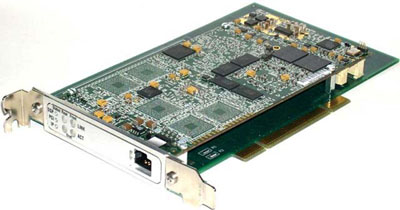
SigC5561 VoIP PCI card for Asterisk IP PBX server |
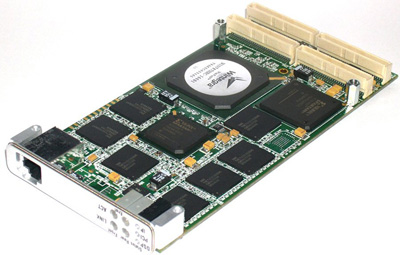
SigC5561 card without PCI adapter, view of front bezel and bottom side. Configurable from 1 to 12 high-density Texas Inst TNETV3010 VoIP chips. Each chip has six (6) cores capable of 32 channels each of carrier grade VoIP, including echo can and voice codec |
- Asterisk DSP Card--Overview
- VoIP Overview
- VoIP Feature Summary
- PSTN Interface Options
- Software Support
- Channel Capacity Table
- Simultaneous Capacity Table
- Specifications
- Per Channel Pricing
In Asterisk TDM-to-IP and IP-to-IP applications, the SigC5561 card acts as
an Asterisk-controlled DSP card.
In a typical Asterisk TDM-to-IP VoIP application, the SigC5561 card
processes TDM channels of 64 kbps PCM (G711) voice, fax or data traffic.
Voice data is optionally compressed via G729AB, G723, GSM-AMR, EVRC, iLBC,
or other LBR codec. In addition, the SigC5561 card provides RTP, RTCP, or
T.38 packetization of voice and fax data, and a comprehensive range of
voice and data telephony functions.
In a typical Asterisk IP-to-IP transcoding application, the SigC5561 card
transcodes between one type of LBR codec and another, for example between
G729AB and G723, or G729AB and GSM-AMR, using embedded logic on the board
to allow internal PCM loopback and framesize adjustment.
Mixed VoIP and transcoding applications are supported.
For advanced applications, an optional WinPath network processor provides
packet formatting, segmentation, reassembly, and routing functions
directly on the SigC5561 card, without host intervention, including direct
GbE or 10/100 interfaces to RJ-45 connectors.
SigC5561 card highlights include:
up to 2304 G.711 channels, 1152 G.729AB or iLBC channels, and/or 864 G.723 or GSM-AMR channels configurable echo can, VoIP and transcoding operation each VoIP channel independently configurable for echo can, voice codec, and other parameters WinPath 7x7 network processor and direct GbE and 10/100 network RJ-45 connections
Voice codecs, echo cancellation, and voice quality monitoring
are good examples of "DSP real-time processing" performed far
more efficiently and at far lower cost using the SigC5561 card
than using server arrays based on multi-core x86 processors.
At higher channel capacities, for example 120 or more, adding
one or more SigC5561 cards triggers a cascade of cost savings,
eliminating LBR codec IP/royalty fees, reducing electric and
cooling costs, and reducing required physical space. In
effect, each server is maximized for efficiency and the waste
and high cost caused by "motherboard farming" is eliminated.
In a typical VoIP application, the SigC5561 card processes TDM channels of 64 kbps PCM (G711) voice, fax or data traffic. Voice data is
optionally compressed via G729AB, G723, GSM-AMR, EVRC, iLBC, or other LBR codec. In addition, the SigC5561 card provides RTP,
RTCP, or T.38 packetization of voice and fax data, and a comprehensive range of voice and data telephony functions.
In a typical transcoding application, the SigC5561 card transcodes between one type of LBR codec and another, for example between G729AB
and G723, or G729AB and GSM-AMR, using embedded logic on the board to allow internal PCM loopback and framesize adjustment.
Mixed VoIP and transcoding applications are supported.
For advanced applications, an optional WinPath network processor provides packet formatting, segmentation, reassembly, and routing
functions directly on the SigC5561 card, without host intervention, including direct GbE or 10/100 interfaces to RJ-45 connectors.
There are three (3) ways to interface PSTN lines, also known as TDM or PCM data, to the SigC5561 card:
TDMoIP protocol. TDM-over-IP protocol, also referred to as CESoPSN, may be used. In this case, TDM data is transported
on the GbE interface to the SigC5561 card, where it is "interworked" by the WinPath network processor into TDM format data
and routed to the TDM side of the DSP farm. TDM channel capacities up to 2304 full-duplex channels are possible per
SigC5561 card.
Below are VoIP features included with all configurations of the SigC5561 Card.
Following Features Require Optional Network Processor
TDM Protocols
CESoPSN (TDMoIP)
VoATM
AAL0 (raw cell)
Network Packet Switching
Example: G.729AB / RTP G.726 / AAL2
Packet Aggregation and Processing
Running default Control Path Software (CPS) and Data ATM Adaptation layers AAL0, AAL1, AAL2 and AAL5 ATM traffic
shaping M traffic shaping M traffic shaping M traffic shaping for CBR, VBR,
GFR and UBR, compatible with ATM Forum TM-4.1 Up to 64k simultaneous channels (VC or VP) with per-VC queuing ATM cell and CPS switching up to 622 Mbps full duplex AAL1
-- supports structured and unstructured Circuit Emulation Services (CES
2.0) ATMF-0078 IMA -- Inverse Multiplexing over ATM in one or more IMA groups according to
ATMF 0086.001 IP Termination -- support for IPv4 (including TOS, TTL, Header processing). IP Routing -- support for IPv4, RFC 1812 (including TOS, TTL, Header
processing) IP Interworking Per flow WFQ and shaping Routing and forwarding over ATM (RFC 1483/2684) IP routing and forwarding over PPP (RFC 2364/2472) and PPP-Mux (RFC 1661) Supports IPv4 IP routing and forwarding over Ethernet (RFC1042) IP Classification -- supports Multi-field Classification and Differentiated
Services according to RFC 2474 and 2475. Algorithmic with single or multiple
passes (without external CAM)
Asterisk software support includes Linux drivers and install scripts. For open
source VoIP and application-specific programming,
DirectDSP software is
available that allows host C/C++ programming interface to the card. WinXP and
Win9x drivers and Win version of DirectDSP software are also available.
The SigC5561 card may also be used with applications other than Asterisk; the C5561 card driver and API fully support user-defined application software.
The table below gives channel capacities for available configurations of the SigC5561
card, including 2 DSPs, 7 DSPs, and 12 DSPs. Note that all channels include 64 msec
echo cancellation.
ITU Codecs
The table below gives IP-to-IP simultaneous call figures assuming one
call leg is G.711. "IP-to-IP" is typically referred to as transcoding.
Note that G711 leg includes 64 msec echo cancellation, if required by the application.
For transcoding between "asymmetric" LBR codecs, where both call legs are not
G711, channel
capacity is typically reduced by half. This situation is sensitive to various application-specific factors; for more information, please
call or email to discuss with Signalogic engineers.
Below are specifications for the SigC5561 card. All specifications are subject to change.
Dimensions
4.3 x 7.44 x 0.5" (109 x 189 x 12.7 mm)
Length measured from surface of back-plate, height measured from
surface of motherboard, width less than single slot
Up to 12 Texas Instruments TNETV3010 devices with
Optional Network Processor
Wintegra WinPath 747 or 787 Access Packet Processor
PCI Bus Interface
32-bit, 33 MHz PCI; 3.3V signaling with passive adapter, 5V signaling with active adapter
PCIe Bus Interface
4x or higher, up to 133
MHz clock rate,
differential signaling per PICMG v1.3, active adapter including PCIe-to-PCI
bridge
Power Consumption
10W in 2 DSP configuration
16W in 7-DSP configuration
23W in 12 DSP configuration**
Temperature
Operating:
0ºC to 55ºC (airflow >200 LFM)
Storage:
-40ºC to 85ºC
Humidity
Operating:
10 to 90% non-condensing
Storage:
5 to 95% non-condensing
Designed to Meet
FCC Part 15 Subpart B
Pricing for the SigC5561 card starts at about $15.60 per channel (for example, 192 G.729
+ echo channels), scales to about $9.5 per channel (672 G.729 + echo channels), and then
scales to about $7.54 per channel (1152 G.729 + echo). These figures are for small
quantity (5 or less); additional price reductions are possible with higher quantity.
Using TDM-to-IP G.711 + 64 msec echo as an example, pricing starts at
about $7.80 per channel for 384 channels, and drops to about $3.77 at
2304 channels.
Unlike a PC software situation, no per-channel royalty cost is required; all IP fees
are embedded within the hardware cost, and in turn within the Texas Instruments voice
chip cost.
** Worst-case figures, measured under full load "stress conditions" with voice software running LBR codec and 64 msec on all channels
Asterisk is a trademark of Digium, Inc.
Asterisk DSP Card--Overview
VoIP Overview
PSTN Interface Options
VoIP Feature Summary
Voice Compression (CODEC)
G.711 (64 kbps m-law or A-law)
G.711.1 (Appendix A) Packet Loss Concealment
G.722 wideband (48, 56, 64 kbps)
G.723.1 (24, 40 kbps)
G.723.1A
G.726 ADPCM (16, 24, 32, 40 kbps)
G.727 ADPCM
G.728 (16 kbps)
G.729 (8 kbps)
G.729AB (8 kbps)
G.729D (6.4 kbps)
G.729E (11.8 kbps)
GSM FR, GSM EFR, GSM AMR
EVRC
SMV
iLBC
QCELP13
FAX
T38U
CID
CONF
Echo Cancellation
G.165 and G.168 64 msec nominal. Up to 128 msec
with multiple reflection cancellations; includes Telogy
proprietary enhancements
Jitter Buffer
Packet playout unit; Telogy packet-loss mitigation options
Silence Suppression
VAD, CNG, Telogy proprietary
G.723.1A
G.729AB
GSM FR
GSM EFR
Fax Relay / Pass-Thru:
T.38 TCP/IP
FRF.11
AAL2 I.366.2
V.17 @ 7.2, 9.6, 12, 14.4 kbps
V.27ter @ 2.4, 4.8 kbps
V.29 @ 7.2, 9.6 kbps
T.30
Modem Relay / Pass-Thru:
V.92
V.90
V.34
V.32bis
V.22bis
V.21
V.23
Bell 212, 103
V.42 MNP 2-4, V.44 MNP 5
Modem Transparency: auto-switch from G.7xx to G.711
on fax or modem detection
ISDN
Sync-mode PPP, HDLC framed PPP
V.110
56k rate adaptation
VoIP
Standards
Compliance
RTP
RTCP per RFC 1889/1890/2508
UDP/IP header
Security
SRTP (RFC 3711)
In-Band Signaling / Call Processing
DTMF, MF R1, MF R2, MFC, SS7 COT, SF, Call Progress for T1 CAS
Out-of-Band Signaling / Call Processing
DTMF Relay (RFC 2833)
Rx, Tx Gain Control
Programmable ±31 dB
H.110 subset (also known as CTbus)
Standards
Compliance
AAL1
AAL2 I.366.2
Path Software (DPS) builds, the WinPath 747 or 787
Communications and Network Processor provides:
Software Support
Channel Capacity Table
Description
Codec
2 DSPs
7 DSPs
12 DSPs
G.729
G.723
G.726
G.711
G.711 App 1
Fax, T38
192
144
192
384
336
384672
504
672
1344
1176
1176
1152
864
1152
2304
2016
2016GSM Codecs
GSM FR
GSM EFR
GSM AMR144
144
144504
504
504
864
864
864
CDMA Codecs
EVRC
SMV
QCELP13
96
96
96336
336
336
576
576
576Cable Codecs
iLBC
G728
G729E
Fax, T38
96
96
96
192
336
336
336
672576
576
576
1152Simultaneous Call Capacity Table
Description
Codec
2 DSPs
7 DSPs
12 DSPs
ITU Codecs
G.729
G.723
G.726
G.711 App 1
Fax, T38
192
144
192
336
384672
504
672
1176
1176
1152
864
1152
2016
2016GSM Codecs
GSM FR
GSM EFR
GSM AMR144
144
144504
504
504
864
864
864
CDMA Codecs
EVRC
SMV
QCELP13
96
96
96336
336
336
576
576
576Cable Codecs
iLBC
G728
G729E
Fax, T38
96
96
96
192
336
336
336
672576
576
576
2016Specifications
DSP Farm
Premium Carrier Grade Telogy Software; includes indemnification
of essential patents for conformance & interoperability
EN55022
EN55024
UL60950 3rd edition
UL60950 3rd editionPer Channel Pricing