


SigC67xx-SODIMM Quad C67xx DSP Module
|
|
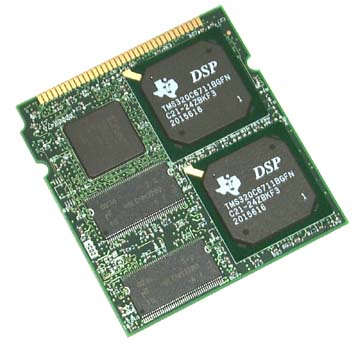
SigC67xx-SODIMM DSP plug-in module top view is shown above.
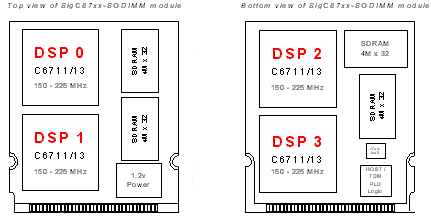
One side contains two (2) 150 MHz C6711 processors (performance boost to 200MHz in 4Q03), two (2) 4M x 32 SDRAM devices, and Host/TDM routing logic, and the other side contains two (2) additional C6711 processor and SDRAM pairs, plus optional boot/FLASH EEPROM device.--
Click to see full size picture |
|
SigC67xx-SODIMM module mechanical outline shown above. Each SigC67xx module contains up to 4 processors (two per side). See below for data sheet containing detailed mechanical drawings. |
- Feature Summary
- Applications
- Advantages
- Processors
- Optional Boot / FLASH EEPROM
- Host Interface Logic
- TDM Routing Logic
- SigC67xx Development System
- Analog I/O
- Specifications and Data Sheets
- Software Support
- PC/104 DSP Card
- PCI DSP Boards
- SigC54xx and SigC55xx Modules
- PMC DSP VoIP/VoATM Card
- Return to DSP Hardware Page
Feature Summary
- Quad C67xx: up to 5.4 GFLOPS 32-bit floating-point performance, if maximum four (4) C6713 processors are installed
- 4M x 32 offchip SDRAM and 64k x 32 zero-wait-state onchip SRAM per processor
- Very small form-factor, 60mm x 67mm; fits in 72-pin SODIMM socket
- Supports C6711, C6712, and C6713 DSP types, including 150 MHz C6711B, 200 MHz C6711C (available 4Q 2003), 225 MHz C6713, and 100 MHz C6712
- On-module TDM routing logic under software control, to allow flexible serial port and TDM signal routing at the module edge and between DSPs
- Supported by SigC67xx-PC/104 board, SigC67xx-PCI board, and SigC67xx Development System, all of which are compatible with DirectDSP®, and Hypersignal®-Macro development software (see below)
- 16-bit HPI host-port, TDM / buffered serial port, external interrupt, and reset signals available at module edge
- Cookie EEPROM with I2C serial interface stores host configuration data
- Optional boot / FLASH EEPROM stores boot or program code, configuration and other non-volatile application data
- JTAG signals are chained between DSPs and available at module edge
- 4-channel audio CODEC SODIMM module also available
Applications
Applications for SigC67xx modules include radar, sonar, control systems, medical, base stations, high precision FFT, wavelet, and other transform processing, VoIP (voice-over Internet protocol) networking functions, VoDSL (voice-over DSL), Internet routing, multiple-channel speech or audio code / decode (e.g. G.729A or MELP speech compression and MP3 audio compression), moderm banks, echo cancellation, and speech recognition. The module approach is particularly well suited to providing a scalable solution for defense electronics, telecom, and Internet equipment applications that require a high number of DSP devices. For example, channel capacity is highly configurable.Advantages
SigC67xx-SODIMM module, offers Quad C67xx processing power in small package, provides multiprocessor DSP solutions for defense electronics, telecom, Internet routing, and network infrastructure applications. The modular approach to multiple DSP processing offers higher density and performance, lower-cost, and several advantages for OEM products:- base-board design is simplified and fabrication risk is decreased
- modules can be upgraded easily, as faster and more capable Texas Inst. DSP devices become available
- for custom applications, it is straightforward to specify a module with fewer processors and more memory, or vice versa
- SigC67xx modules are supported by standard, off-the-shelf software tools, including DirectDSP, Real-Time Composer™, and Hypersignal-Macro software
Processors
The Texas Instruments C67xx 32-bit floating-point DSP family offers high performance, flexible external memory interface, and a rich set of onchip peripherals. The TMS320C6711, C6712, and C6713, including 150 MHz C6711B, 200 MHz C6711C (available 4Q 2003), 225 MHz C6713, and 100 MHz C6712 digital signal processors range from 100 to 225 MHz (600 to 1350 peak MFLOPS, or 240 to 540 general-purpose code MFLOPS) in processing capability. They offer a complete set of onchip peripherals depending on processor type, including serial ports, host port, PLL, timers, DMA channels, and up to 128k x 32 onchip memory. Cost/performance tradeoff possibilities range from the C6711, an extremely cost effective solution, to higher performance processors, such as the C6713.Boot / FLASH EEPROM
The SigC67xx-SODIMM module contains a 4M x 16 boot / FLASH EEPROM that stores boot or program code, configuration and other non-volatile application data.Host Interface Logic
The SigC67xx-SODIMM module contains PLD logic that multiplexes module edge HPI (Host Port Interface) signals for multiple DSPs and allows one or a combination of DSPs to be accessed simultaneously during host writes (broadcast mode), and individually during host reads. Broadcast mode includes onchip memory block writes, DSP program (COFF) file download, reset, run, and external interrupts.TDM Routing Logic
The SigC67xx-SODIMM module contains PLD logic that allows flexible serial port/TDM routing capabilities. For example, all DSPs can see the same TDM bus, or be routed to separate serial ports at the module edge. Also, DSPs may communicate to each other via high-speed synchronous serial port. This flexibility allows TDM streams to be tailored to fit the natural architecture of the C67xx DSP family and facilitate DSP software development.SigC67xx Development System
For more information on the SigC67xx Development system, please click here. Note that the SigC67xx-PC/104 board may also serve as a development system, if plugged into a PC using a "passive carrier" card. More InformationAnalog I/O
For more information on the SigSD4 Audio Module, please click here.Specifications and Data Sheets
- SigC67xx-SODIMM Module Data Sheet (111 KB)
- SigC67xx-PC/104 Board Data Sheet (759 KB)
- PCB/Layout Images
SigC67xx Module Software Support
The SigC67xx-SODIMM module, offers Quad C67xx processing power in small package, as well as other C67xx platforms such as the Texas Instruments DSK C6711 and M67 boards, are supported by Signalogic off-the-shelf DSP software products designed for DSP-based real-time processing and C67xx DSP code development, including:- Hypersignal®-Macro and Hypersignal-Acoustic software series, which offer a number of simulation and real-time instrument functions. Simulation functions include DSP and math functions, time domain display (including waterfall, contour, magnitude, unwrapped phase), difference equation, digital FIR and IIR filter design, sampling rate conversion, frequency zoom, wavelet transform, minimum phase calculation, and many more. Instrument functions include spectrum analyzer, digital oscilloscope, stimulus & response measurement, continuous signal generation, real-time; "snap-in"; filtering, continuous disk record and generate, and more.
- DirectDSP® is a Windows library that provides low-level and high-level calls for user-defined C/C++, Visual Basic, MATLAB®, or LabVIEW® programs. The DirectDSP API includes low-level hardware control functions such as reset/run/hold, register access, block memory transfer, DSP executable file download, etc. High-level functions include waveform file acquire/generate, continuous signal generation and execution of any arbitrary Hypersignal DSP or math function. DirectDSP includes strip-chart recorder, digital oscilloscope and digital tape recorder demo program and source code examples.
- The C67xx Source Code Interface contains numerous C67xx algorithms and functions in source and binary form, such as optimized FFTs, filters, matrix, transcendental, trig, signal manipulation function, processor and card initialization and analog I/O examples, etc. These functions form the basis of higher-level software functions and instruments; modification can be used to customize Hypersignal or DirectDSP software operation. User-defined C routine hooks are provided for real-time algorithm development. The C67xx Source Code Interface can be used as a basic foundation for user-defined real-time DSP systems and products