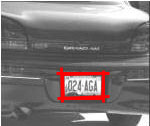
SigCAM utilizes the power of DSP (digital signal processing) to
dramatically improve the quality of video based security and surveillance
systems. The DSP device constantly -- in real-time -- monitors video image frames
for human faces and license plates. When candidates are found, SigCAM
instructs the camera to pan (if supported by the camera) and briefly zoom in.
Resulting processed output by SigCAM video offers increased resolution frames of candidate
faces and license plate tags, enabling security system officers and law
enforcement an improved opportunity to discern and identify crucial information.
SigCAM can also provide motion-detect functions, and instruct the
camera to zoom on areas of the image where motion is detected. An audio alarm option may be enabled for motion detection, and an IR sensor
is also available to enhance alarm reliability.
In a system where the camera does not have pan and/or zoom capability,
SigCAM can still provide improved and useful results by focusing its
signal processing resources on candidate faces and license plates, for
example using image enhancement algorithms to improve contrast and quality of those
areas of the image. Enhanced processing may also be enabled on image areas where motion is detected.
SigCAM includes an RS-232 output to provide movement instructions to the camera,
and supports command/data formats for a number of popular cameras.
SigCAM Applications
Existing security or surveillance system upgrade. Connect SigCAM to
existing video signals, mount on the wall, connect AC adapter, and you're
ready to go.
New systems. Install SigCAM plus a recommended camera in any security or
surveillance situation that would be a candidate for a camera alone. Recommended
cameras include motorized pan and zoom and a "Control Port" that allows SigCAM to
send instructions to the camera for pan and zoom control.
SigCAM Operating Modes
The SigCAM offers a straight "plug n play" mode that simply inserts the
SigCAM in your raw video signal. In this mode, you simply connect your
current camera to the SigCAM video input, and connect SigCAM video output
to where ever it was previously connected. SigCAM supports S-video,
composite video, and RGB video I/O, including NTSC, PAL, and PC video
formats.
SigCAM Video I/O
S-Video Out Connector
S-Video Out "mini-DIN" is a four pin connector which provides video output.
Video Out - RED and Pr
Video Out RPr is a RCA jack which drives the RED signal when SigCAM input is in RGB mode. This output is also used in HDTV mode to drive the Pr component of the video.
Video Out - Green and Y
Video Out GY is an RCA jack used to interface to the GREEN or composite video of the display device. This output is also used in HDTV mode to drive the Y component of the video.
Video Out - Blue and Pb
Video Out BPb is an RCA jack used to interface to the Blue of an RGB device. This output is also used in HDTV mode to drive the Pb component of the video.
PC Video Output Connector
PC Video output can be connected to a standard personal computer monitor 15-pin high-density female D-connector.
Composite Video 1 Input Connector
Composite Video Input is an RCA jack used to input from composite video source.
S-Video Input Connector
S-Video Input is a four pin mini-DIN connector which can connect to an S-video input source.
Composite Video 2 Input Connector
Composite Video 2 Input is an RCA jack used to connect to a second composite video source.
SigCAM Digital I/O
The SigCAM also supports digital output in either RS-422 or Ethernet
10/100 formats. Digital output can be provided in compressed format using
MPEG2, MPEG4 (AVC), DIVX, motion JPEG, or other popular formats.
Compressed data rates can be up to 4 Mbps. The DSP device handles data
compression in real-time, so there is no decrease or gap in system
performance.
The Power of DSP
DSP, or Digital Signal Processing, is the art and science of extracting useful
information from physical signals found on our planet. Sound, pressure, temperature,
seismic, radar, heat, and light are some examples. DSP devices are the electronic
chips that do this work -- they are usually small, low-power, but still as
high-performance as the Pentium inside your PC. DSP devices are found in many easily
recognizable products, including cell phones, DVD players, cars¹, MP3 players, and
many others. We like to say that DSP devices go into products that need a Pentium
but are too small to hold a heatsink and a fan².
Until recently, DSP devices have not been fast enough to process images and video in
real-time -- that is to say not fast enough to keep up with smooth, continuous video
and still extract useful information. The latest generation of DSP devices is
changing that. One such example is the Texas Instruments DM642 processor, which can
perform extremely fast calculations and algorithms specialized for image processing
The DM642 is what we use inside the SigCAM and forms the engine that allows SigCAM to
recognize and act on image content -- rather than simply compress and store
images as do typical digital cameras and cell phones.
For more information on the DM642 device, here are some links:
DM642 OverviewDM642 Device
Notes:
¹ DSP devices are found in cars in multiple places, such as anti-lock braking systems and engine monitoring.² A heatsink is the large metal block with "fins" fastened to the Pentium inside your PC. It dissipates the high amount of heat generated by the Pentium processor.Intel and Pentium are register trademark of Intel Corporation.