Super I/O PC/104: Embedded Communications Board
- Overview
- Feature Summary
- Specifications and Data Sheet
- Telephony T1/E1 Interface
- Network Interface
- Serial I/O Interface
- Analog I/O
- Software Support
- SigC54xx-PC/104 DSP Board
- SigC67xx-PC/104 DSP Board
- SigC54xx-SODIMM Modules
- SigC55xx-SODIMM Modules
- SigC6415-PTMC Octal Resource Board
- Return to DSP Hardware Page
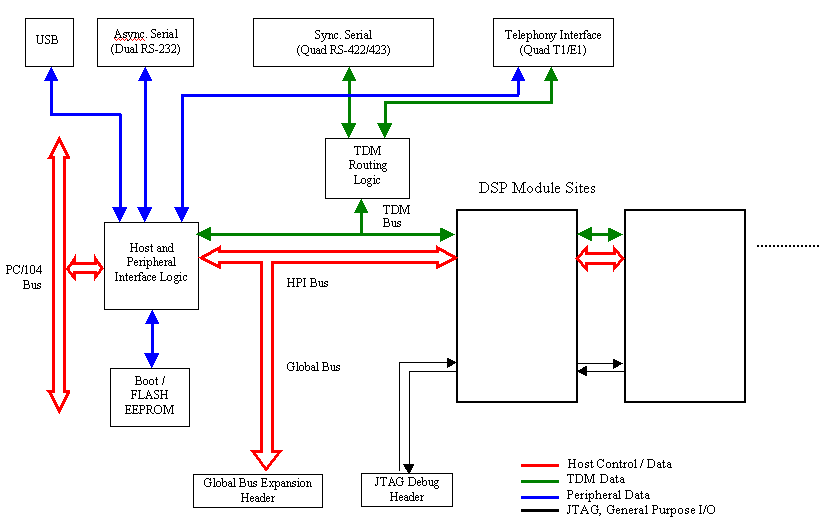
 Super I/O PC/104 board Click here to see full-size pictures.
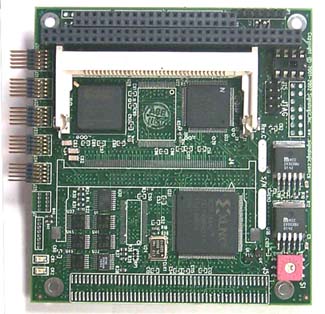
 Super I/O PC/104 Data Flow Diagram Click here to see full-size pictures.
|
Overview
The Super I/O PC/104 board provides a wide variety of I/O options, including network, telephony, and several types of serial I/O. In addition, the board also accepts modules with Texas Instruments C54xx, C55xx, or C67xx DSP processors and modules with 16-bit audio, speech, or other analog I/O. The Super I/O board is suitable for defense electronics, embedded telecom, Internet infrastructure, or data acquisition and measurement applications where space is at a premium. Applications for the Super I/O board include embedded LAN and WAN communications, measurement and data acquisition, base-station processing, VoIP (voice-over Internet protocol) networking functions, VoDSL (voice-over DSL), Internet routing, multiple-channel speech or audio code / decode (e.g. G.7xx, GSM, or MELP speech compression and MP3 audio compression), modem banks, echo cancellation, and speech recognition. The modular expansion approach used by the Super I/O board is particularly well suited to providing a scalable solution for defense electronics, telecom, Internet equipment, and data acquisition/measurement applications that require multiple DSP devices. For example, channel capacity is highly configurable and upgradeable. The Super I/O board is a PC/104 format board, fully compliant with PC/104 specification v2.3 in dimensions and mechanical considerations.PC/104 Base Board Feature Summary
- High-speed host interface
- Dual RS-232 serial ports
- Quad RS-422/423 synchronous serial ports
- USB interface
- Quad T1/E1 telephone interface (integrated framer / transceiver)
- 10/100 Mbps Ethernet controller with integrated transceiver
Supports mutichannel analog I/O interface with SigSD4 Audio Module or other analog I/O modules installed
- Up to four (4) module sites for C54xx or C55xx processors and analog or audio I/O
- Flexible onboard TDM stream routing, via programmable PLD switch matrix under host software control
- Global Bus expansion header, with parallel digital I/O
- 1149.1 JTAG header
- Supported by DirectDSP® software
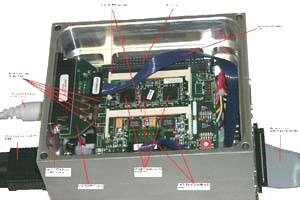 Application example of Super I/O board with DSP
 modules installed. Click to see blow-up picture and captions. |
Specifications and Data Sheets
- Super I/O PC/104 Data Sheet (717 KB)
- SigC54xx-PC/104 Data Sheet (2399 KB)
- Application Board and Enclosure Example
- SigC54xx-SODIMM Module Data Sheet (341 KB)
- SigC55xx-SODIMM Module Data Sheet (407 KB)
- Application External Cabling Example (7 KB)
- Application Internal Cabling Example (13 KB)
Telephony T1/E1 Interface
The Rev. C Super I/O board contains a Dallas Semiconductor DS2155 device with integrated framer/transceiver that provide a T1/E1 interface available on a header at the board edge. The Rev. D card contains a PMC-Sierra PM4354 device with integrated framers and transceivers that provides a quad T1/E1 interface at headers on the board edge. Up to 96 data streams may be processed by the module sites. Command, control, and status information is available to the host interface, and all TDM data is routed to the DSP module sites, via the programmable PLD switch matrix.Network Interface
The Rev. D Super I/O board contains a 10/100 Mbps Ethernet controller with PHY signals available on a header at the board edge. Rev. C boards do not contain the Ethernet controller. For VoIP applications, Packet data may be output to the network from DSPs after speech codec, RTP, and jitter processing. The Ethernet controller is accessible from both host and module sitesSerial I/O Interface
The Super I/O board provides four (4) synchronous serial channels and two (2) RS-232 asynchronous serial channels. All serial I/O signals are available at board edge; routing is performed using onboard CPLD logic, and software programmable. Levels are software-programmable for either RS-422 or RS-423 (balanced or unbalanced). The Rev. D version of the Super I/O board also includes a single channel USB interface.Analog I/O
Combined with SigC54xx or SigC55xx processor modules, the SigSD4-SODIMM Audio Module offers multichannel 16-bit sigma-delta analog I/O as an integrated component in the modular solution. Audio Module features include:- sigma-delta converters provide sharp anti-alias and reconstruction filter roll-off, and nearly ideal linear phase response
- sampling rates and filter cutoff frequencies are software programmable; all channels are sampled simultaneously
- TDM (time division multiplex) serial output allows distribution of multichannel audio data to one or more DSP processors; audio data can be replicated among processors, or distributed uniformly, as needed
- analog input/output signals are routed directly to the module using a small-outline Mictor 38-pin connector that supports individually shielded conductors.