


Video Transcoding PCI / PCIe Board
Multi-DSP Card for Video Transcoding Applications
** Status: Active for voice and DSP applications, but replaced by next-generation product for video applications. **
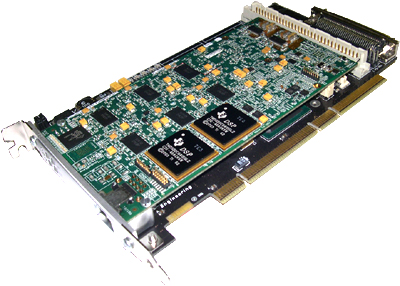
|
| SigC641x PCI video transcoding board |
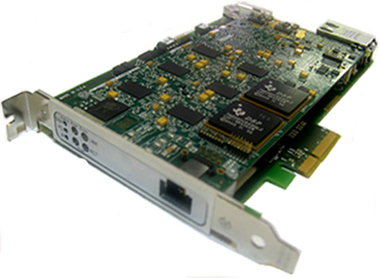
|
| SigC641x PCIe video transcoding board |
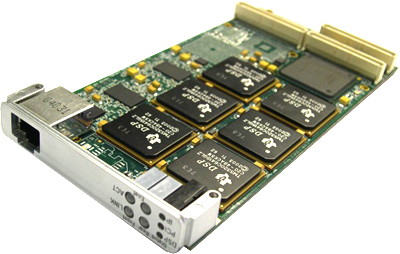
|
|
Bottom side view of SigC641x card without
PCI adapter, showing main section of DSP Farm |
- Overview
- Video Transcoding Feature Summary
- C64x Processor Family
- Block Diagram
- Software Support
- Specifications
- ATCA or cPCI / PCIe Carrier Infrastructure Voice Transcoding Card
- VoIP and Voice Transcoding PCI / PCIe Card
- Real-Time Video Digital and Analog I/O
Overview
The SigC641x card permits PCI / PCIe based platforms to offload video transcoding and image processing tasks, providing high-speed access to a "farm" of powerful DSP devices. Video compression algorithms such as H.264, MPEG-2, and WM9, can be run in combination on one or more DSPs, allowing multi-channel operation. Video algorithms such as pattern recognition, motion detection, and other numerically intensive image processing tasks are also supported. Channel capacity depends on the nature of the algorithms, and whether operation is 'full-duplex'; i.e requiring both encode and decode. The SigC641x board was designed to provide high-speed access to the DSP farm. Flexible, programmable logic fronts the farm and contains large memory buffers that allow host processor applications, via Linux or WinXP drivers, to "fire data and forget", moving to the next channel data set. The interface between the logic and DSP farm is 32-bit wide, unlike other boards that implement 16-bit or even 8-bit interfaces to the DSP devices. The SigC641x card fully supports Texas Instruments tools for developing real-time, C code based algorithms, including Code Composer Studio (CCS) software, XDS 510 and XDS 560 based JTAG emulators, DSP/BIOS operating systems, and CSL (chip support library) for C64xx devices. Host software support includes WinXP and Linux drivers, and DirectDSP software API. Host platform software options include:- Linux
- WinXP, Win2k, Win9x
- using the optional network interface, operation as a self-managed unit, with no PCI / PCIe bus communication
Video / Image Processing Feature Summary
Below is a video / image processing feature summary for the SigC641x board.- Video compression algorithm support including H.264 (MPEG-4), H.263 (MPEG-2), WM9, DivX, motion JPEG, and more
- Image processing and security application algorithm support; examples include pattern recognition, advanced false-positive resistant motion detection, and face or license plate recognition
- Medical application algorithm support; examples include image enhancement, 3-D spectrograph, visualization, and real-time video processing
- IP video support, including real-time frame processing
- High-speed PCI / PCIe-to-HPI32 data transfer, including dual-buffers and broadcast mode
- Optional PCI / PCIe-to-TDM data transfer, with TDM data routed to DSP serial port array
- Up to eight (8) 6414, 6415 or 6416 32-bit fixed-point, DSPs with clock speeds from 720 MHz to 1 GHz. Each DSP includes 1 Mbyte onchip memory and L-2 cache
- Optional 4, 8, or 16M x 32 SDRAM per DSP
- Optional front-panel 10/100 interface (RJ-45)
- Optional 8 or 16M x 8 Flash EEPROM for DSP program boot, also available for non-volatile data storage
- Optional 128M x 8 NAND Flash EEPROM, for streaming media data storage
- Fully compliant with Texas Inst Code Composer Studio (CCS) software; JTAG emulator header located on the board. JTAG chain configuration options include all DSPs, any DSP bypass, and chain truncation
- Host software support includes DirectDSP software, which provides C/C++ API in Visual Studio (WinXP) and GCC (Linux) environment, and also provides MATLAB and Visual Basic interfaces
- DSP software support includes C64xx SCI board-support software, which provides DSP level board support package, including example CCS projects, drivers for host PCI / PCIe interface, DMA controller access, and onboard peripheral access
C64x Processor Family
The 6414, 6415, and 6416 processors are next-generation TMS320C6000 series devices, commonly known as C6x family devices, replacing older 620x and 6412 devices. Each 6414, 6415, or 6416 DSP on the SigC641x card can execute up to 8000 MIPS (4000 MACs) when running at 1 GHz clock rate, or 6.4 GIPS maximum board performance. Each C64xx device includes 1M byte onchip fast SRAM memory, L-1 program and data cache, configurable L-2 data cache, and a range of peripherals including McBSP serial ports, Level 1 UTOPIA, 32-bit Host Port, and 16-bit GPIO. The CPU core in the C64x includes six (6) ALUs (32-/40-Bit). Each ALU supports single 32-bit, dual 16-bit, or quad 8-bit Arithmetic per Clock Cycle, two simultaneous multipliers supporting four (4) 16 x 16-bit multiplies (32-bit results) or or eight (8) 8 x 8-bit multiplies (16-bit results) per clock cycle. The 6414 processor provides a low-cost option if "back end" UTOPIA interface to the DSP Farm is not needed, for example PCI / PCIe-to-HPI32 and/or PCI / PCIe-to-TDM interfaces are sufficient. The C6416 processor provides additional Viterbi Decoder Coprocessor (VCP) and Turbo Decoder Coprocessor features. The VCP supports over 500 7.95 Kbps AMR with programmable code parameters, and the TCP supports up to six (6) 2-Mbps 3GPP (6 iterations), with programmable Turbo Code and decoding parameters.Block Diagram
Below is a block diagram for the SigC641x card.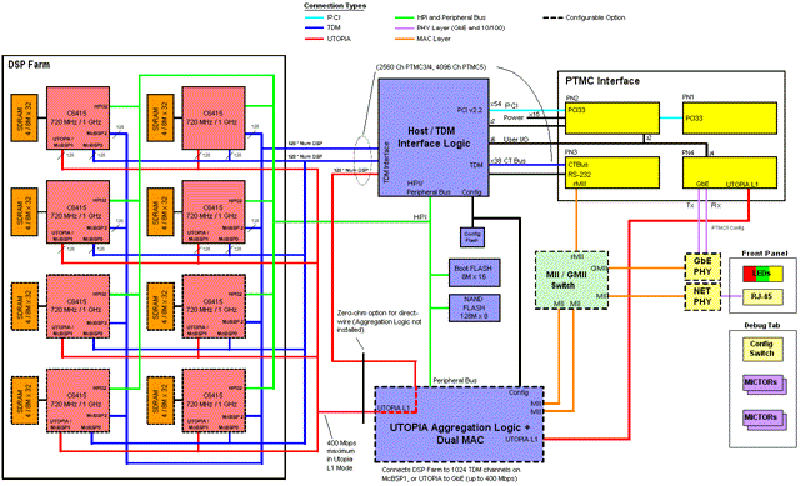
Software Support
The SigC641x card fully supports a wide range of DSP software development and integration, including voice, audio, video, and wireless algorithms, real-time processing. The C64x SCI software provides a board-support package, including example Code Composer Studio (CCS) projects, drivers for host PCI / PCIe interface, DMA controller access, and onboard peripheral access. C64xx SCI supports both "host mode", when some type of host interface is used over the PCI / PCIe bus (typically application layer software running on WinXP or Linux), and "JTAG mode", when only CCS and a JTAG emulator are active. Both host and JTAG modes may be active simultaneously. Via the PCI / PCIe bus, DirectDSP software provides C/C++ API in Visual Studio (WinXP) and GCC (Linux) environment, based on WinXP kernel mode drivers and Linux loadable kernel module drivers. Under WinXP, DirectDSP software also provides MATLAB and Visual Basic interfaces. Hypersignal-Macro software provides test and diagnostic utilities, and instrumentation displays under WinXP and Win9x. Legacy Win9x systems are supported by VxD drivers. Debug during DSP software development and coding is supported at two levels:- host PCI / PCIe bus “algorithm level interface”
- JTAG emulator “chip level interface”
Specifications
Below are preliminary specifications for the SigC641x card. All specifications are subject to change.| Dimensions | 4.3 x 7.44 x 0.5" (109 x 189 x 12.7 mm) Length measured from surface of back-plate, height measured from surface of motherboard, width less than single slot |
| Front Panel | Optional RJ-45 10/100 interface Status, DSP, PCI / PCIe, and optional network indicator LEDs, including 10/100 and GbE link and activity indicator LEDs |
| DSP Farm 1 | Up to eight (8) 6414, 6415 or 6416 devices (720 MHz, 850 MHz, or 1 GHz) |
| PCI / PCIe Bus Interface | 32-bit, 33 MHz PCI / PCIe; 3.3V signaling with passive adapter, 5V signaling with active adapter |
|
Power Consumption 1, 2 |
Approx 13W @ 5V Approx 13W @ 3.3V |
| Temperature | Operating: 0 to 55ºC (airflow >200 LFM) Storage: -40 to 85ºC |
| Humidity | Operating: 10 to 90% non-condensing Storage: 5 to 95% non-condensing |
| Designed to Meet | FCC Part 15 Subpart B EN55022 EN55024 UL60950 3rd edition IEC60950 3rd edition |
2 Approximate estimate only.