MELPe Linux Software for x86 and Arm

|
- MELPe
- Overview
- Feature Summary
- MELP / MELPe Development System
- VDS Software
- SigC5xxx Development System
- SigC5xxx-PC/104 Board "MELP Production System"
- MELP Communication, Modem and HF Radio
- Software and Debug Support
- Speech Codec Wav Samples
- President's Notice for Mil/Gov Contractor Management
 |
|
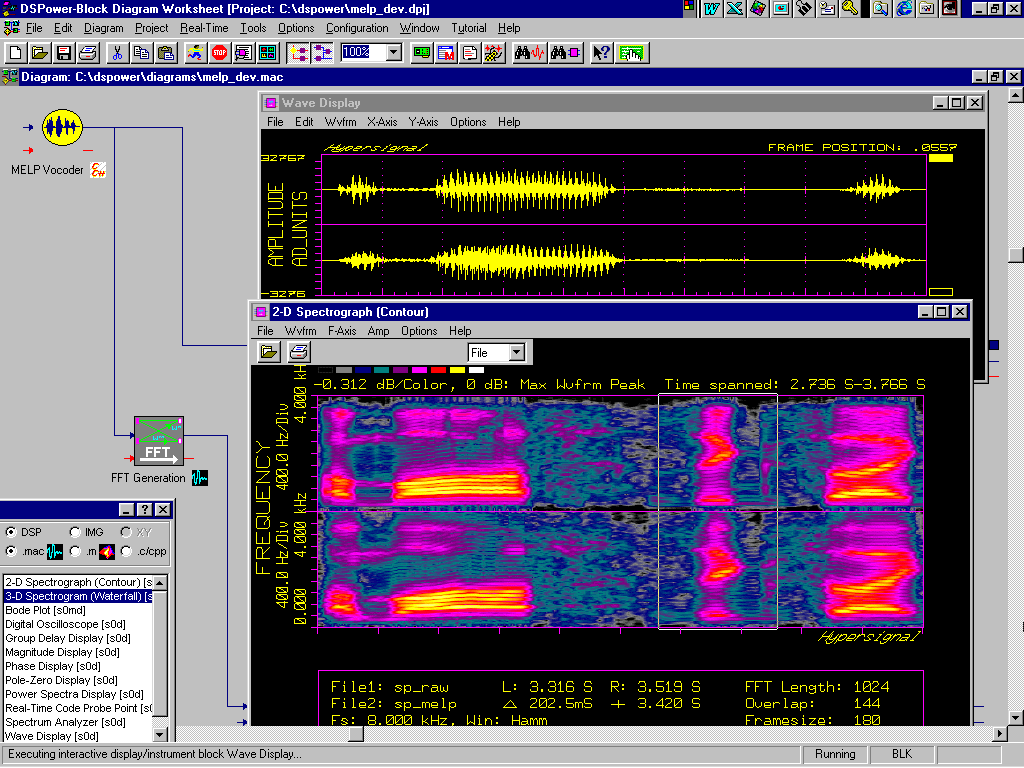
Frequency domain (2-D spectrograph) and time domain (waveform display/edit) graphs of pre-MELP speech data (trace 1) and MELP-processed speech data (trace 2). Click here to listen to the raw waveform sample and MELP-processed waveform sample |
 |
|
Same data as above, with waveform zoom. Click here to listen to the raw waveform sample and MELP-processed waveform sample |
Note - Texas Instruments has discontinued its 54xx, 55xx, c64x, and c66x chip product lines. Signalogic supports MELPe running on x86 and ARM platforms under Ubuntu, CentOS, and Debian at bitrates 2400, 1200, and 600 bps. RFC 8130 is supported to provide RTP packetization to interface with cellular and other RTP packet flow systems.
MELPe command line examples running under mediaTest™ on Linux are here:
MELPe mediaTest™ Linux command line examples Example lab workstation and audio I/O (i.e. not PC audio) examples are here: Lab workstation with audio I/O SDK + demo download pages are here: SDK and Demo Download Reference hardware examples are here:MELPe
In 2000-2007 Signalogic engaged in research efforts for real-time very-low-bitrate codecs, collectively called MELPe-Plus. We developed 300 bps and 600 bps modes, variable framesize (16 msec to 30 msec), alternative mid-range bitrates from 2000 to 4800 bps, improved noise reduction algorithms, and improved speech quality. In 2004 we competed against Harris and Thales in NSA's competition for the 600 bps addition to the STANAG 4591 standard. We placed second to Thales, and since then have fully supported the updated 4591 600 bps standard.Overview [Texas instruments has discontinued C54xx and C55xx devices mentioned on this page]
Signalogic has developed bit-exact, real-time MELP and MELPe (Mixed Excitation Linear Predictive) implementations for Texas Instruments C5xxx DSP processors, based on new government voice compression communication standards for 1.2 and 2.4 kbps (150 and 300 bytes per sec) compressed speech, including US Govt. MIL-STD 3005 and NATO STANAG 4591. MELP is much-improved algorithm that supersedes the previous "LPC10" Vocoder standard. In this process, legacy MELP source code has been reorganized, redundancies removed to take advantage of high C5xxx processing rates, and real-time processing errors corrected. Also, the source has been reformatted to provide multichannel real-time operation, including analog I/O (voice) and digital I/O interrupt-tolerant execution and resolution of C5xxx pipeline issues. Texas Instruments supported DSP devices include C5409A, C5416, and C5421. A C5509A version is under development. The extremely low bit rates of 1200 and 2400 bps (150 and 300 bytes per sec) make the MELPe speech compression algorithm suitable for a wide range of telecom applications, including VoIP (Voice-over-Internet Protocol). Signalogic has demonstrated real-time MELPe on SigC54xx SODIMM multiprocessor modules, which are small form-factor multi-DSP modules used by a wide range of speech acoustic, VoIP, and telecom clients. Supporting modules include the SigSD4 Audio Module, also in SODIMM form-factor, which provides 4-channel 16-bit sigma-delta analog I/O. The SigC5xxx MELP System is fully supported by the SigC5xxx Development System, and DirectDSP software, which provides direct access, analysis, monitoring, and real-time debug capabilities from C/C++ (MSVC and Borland), MATLAB, Visual Basic, and LabVIEW host environments. Production MELP and MELPe systems have been implemented based on the SigC54/55xx-PC/104 board, which provides small form-factor, high-density multichannel MELP performance, suitable for stand-alone operation in rugged environments.Feature Summary
The SigC5xxx MELP System is a low-cost, scalable, modular signal processing approach to voice compression based on fixed-point off-the-shelf Texas Instruments C5xxx DSP devices. Features of the SigC5xxx MELP System include:- Multichannel real-time performance. With one (1) SigC5409A or SigC5416 processor module installed, the SigC5xxx MELPe System is capable of processing and MELP-encoding up to six (6) half-duplex, and three (3) full-duplex channels at 8 kHz sampling rate (16-bit data). Channel capacity is twice that if the older MELP algorithm is used. The MELP/MELPe development system can accept up to two (2) SigC5xxx modules and one 4-channel audio module; the production system either two (2) SigC54xx modules and two (2) audio modules, or three (3) SigC5xxx module and one (1) audio module. Maximum capability of the production system assuming all digital I/O would be 24 full-duplex channels and 48 half-duplex.
- Scalability. The SigC5xxx MELP System provides scalable MELP performance and channel capacity by taking advantage of small, multiprocessor 72-pin SODIMM modules to provide flexible configuration of number of processors, type and performance of processor, and amount of dedicated SRAM per processor. This approach makes different customer configurations and product and field upgrades straightforward.
- Flexible audio interface. A low-cost, simple, SigSD4 Audio Module, based on software-programmable, off-the-shelf Cirrus Logic CS4218 16-bit sigma-delta codec devices, is available which provides serial bitstream interface directly to C5xxx DSP devices, and which provides sampling rate and audio level matching under software control.
- MELP Development System, including multi-module test and development platform with high-speed PC interface, supported by commercial off-the-shelf (COTS) development software tools. The SigC5xxx MELP System is fully supported by Signalogic and Texas Instruments COTS development software tools for Win9x and WinXP platforms, including DirectDSP software, DirectDSP software, Hypersignal-Macro software, and Code Composer JTAG debugger. Host software support includes interface libraries and host API for C/C++ and MATLAB, and C5xxx DSP API including analog I/O initialization and functions.
- Small form-factor for MELP production systems. The SigC5xxx-PC/104 board is implemented in PC/104 form-factor, which allows OEM manufacturers to embed multichannel MELP capability in a volume approximately 3.5" x 3.75" x 1.0"
MELP / MELPe Development System
The MELP / MELPe Development System offers real-time MELP voice compression performance in a PC-based, desktop form-factor suitable for proof-of-concept and application-specific development requirements. The MELP /MELPe Development System is based on theSigC5xxx Development System; the default configuration is four channels of real-time MELP processing. The system can provide vocoded audio output or digital serial output suitable for conversion to RS-232 or RS-423 format for test and measurement purposes. The default-configuration MELP / MELPe Development System:- contains two COTS SigC5xxx-SODIMM modules, in 72-pin SODIMM format, each with three 100 - 160 MHz C5409A or C5416 processors. On these modules, each processor has its own dedicated 128k x 16 SRAM, organized as 32k x 16 Data SRAM and 96k x 16 Program SRAM
- contains one 4-channel, 16-bit sigma-delta analog I/O SigSD4 Audio Module, also in 72-pin SODIMM format. Two of Cirrus Logic CS4218 audio codec devices are used on the Audio Module; each codec is 2-channel and contains both A/D and D/a converters. The sigma-delta converters provide software-programmable sampling rates from 4 kHz to 48 kHz (signal bandwidth from 2 kHz to 24 kHz), built-in anti-alias and reconstruction filters, highly linear phase response, and software-programmable input gain from 0 to +22.5 dB and output attenuation control from 0 to -22.5 dB. (Note: the required bandwidth to be supported by real-time MELP processing is 4 kHz).
- is connected to Win9x host PC using high-speed host-interface card
- is initialized, configured, and controlled by DirectDSP software, with direct interface from C/C++ (MSVC and Borland), MATLAB, Visual Basic, and LabVIEW
VDS Software
 In addition to general development features and popular host environment
support (MATLAB, C/C++, etc.) provided by the
SigC54xx Development System, the
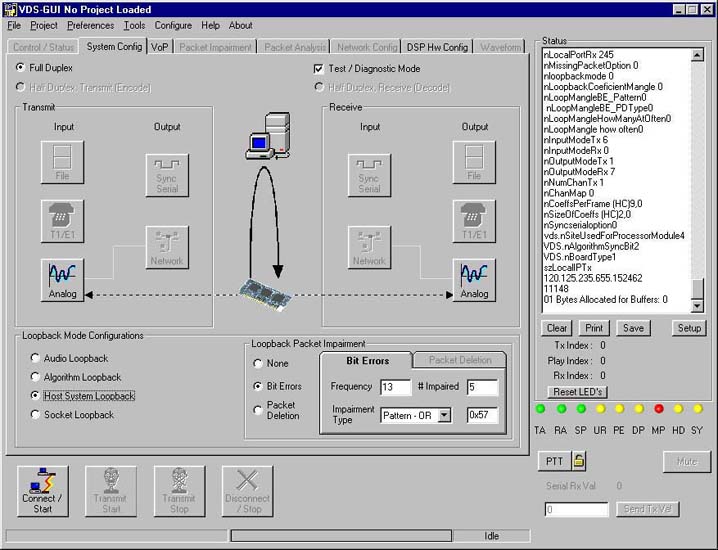
MELP Development System includes VDS software which
provides common voice compression development functions, including:
In addition to general development features and popular host environment
support (MATLAB, C/C++, etc.) provided by the
SigC54xx Development System, the
MELP Development System includes VDS software which
provides common voice compression development functions, including:
- Synchronous serial and other channel transmission options, including sync format, coecficient packing, band rate and protocol settings, etc.
- input/output to TIM, WAV, or ASCII text waveform files
- raw and processed data display, both in time domain and in frequency domain, including 3-D spectrogram and 2-D spectrograph
- packet inpairment testing and analysis, including BER and FER
- real-time measurement capability (e.g. frames per sec), voice quality measurement
- mode control; e.g. file-based simulation, real-time audio input, etc.
- real-time control over voice compression DSP code (including analysis mode, synthesis mode, bit rates, noise processing options, filtering options, transcoding, VAD, and other options)
- input/output to synchronous serial port card in the PC
SigC5xxx-PC/104 Board "MELP / MELPe Production System"
The MELP / MELPe Production System is composed of a multi-module site board in PC/104 form-factor. This board, called the SigC5xxx-PC/104, contains four SODIMM module sites, host PC interface, digital I/O (RS-232 and RS-423) interface and connectors, JTAG debug headers, standard PC/104 bus connectors, and 100-pin "Global Bus" connector for peripheral expansion. The SigC5xxx-PC/104 board can accept SigC5xxx-SODIMM multiprocessor modules, and SigSD4-SODIMM Audio Modules. A standard SigC549-SODIMM module contains three 100 MHz C549 processors and three sets of 128k x 16 SRAM devices. A standard SigSD4-SODIMM module contains two 16-bit, 2-channel sigma-delta codec analog I/O devices and interface circuitry. Audio Modules provide a multiplexed, 128-bit frame, 4-channel serial bitstream suitable for digital I/O interface to SigC5xxx processor modules. Features of the SigC5xxx-PC/104 board include:- fully conforms to PC/104 board footprint, height, and stacking requirements
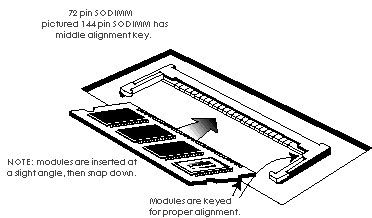
- contains four 72-pin SODIMM sockets, mounted flat (horizontally) on the PC/104 board, two on each side. The approximate area consumed by the SODIMM sockets is 2.5" x 2.75", well within the 3.5" x 3.75" PC/104 board space, and leaves ample room for peripheral circuitry and connectors. The horizontal, flat sockets are surface mount and provide three side PCB containment and spring-loaded metal side brackets which snap into PCB guide holes, offering improved reliability and shock / vibration resistance over vertical or angled SIMM or other mezzanine. See Figure 1 below, SODIMM Module and Socket Example.