


Voice-over-Blue Force Tracking
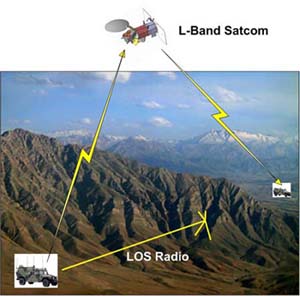
Signalogic VoBFT provides BLOS voice using existing bandwidth and equipment |
- Overview
- Key Objectives
- Summary of VoBFT Features and Operating Parameters
- Mobile Satellite Modem Example
- Tactical Voice Communication Examples
- Mobile Vehicle Initiated Emergency BLOS Voice Comm
- Base Initiated Emergency BLOS Voice Comm
- “Don’t Shoot” Voice Comm
- Base Initiated Vehicle Identity Query
- Additional Information
Overview
Unreliable LOS radio communication in rugged terrain continues to pose problems for tactical forces, including risk of friendly fire incidents and loss of tactical opportunities. These problems are especially crucial in rugged, mountainous terrain, or dense urban areas were radio communication suffers from blockage or multi-path interference. To address these problems and make a contribution to reducing friendly-fire incidents, Signalogic is developing a BLOS (beyond-line-of-sight) voice solution in the form of a small VoBFT unit (Voice over Blue Force Tracking) that attaches simply and directly to satellite modems already installed on Army and Marine vehicles. The VoBFT unit is extremely low-cost, easy-to-use, requires no modem modifications, and does not consume additional satellite bandwidth. The VoBFT unit would provide Army, Marine, and convoy vehicles with emergency BLOS voice using existing BFT infrastructure. Logistics and security situations involving mixed equipment or unreliable radio communication between forces are another expected application.Key Objectives
Primary objectives of the Signalogic VoBFT unit and system-wide approach include:- No change to existing vehicle or base location equipment is required. Specifically, no modifications to existing satcom modems is required, no additional data terminal software required
- No additional satellite channel bandwidth is required
- No effect on existing tracking and data communication until either push-to-talk (PTT) or voice activation occurs
- Extremely small, ruggedized form-factor suitable for easy installation and ease-of-use
- Low power consumption – less than 0.5 W in Flow-Thru Mode, less than 2 W in Voice Mode
- Drop-in “bump in the cable” insertion
Summary of VoBFT Features and Operating Parameters
- Any VoBFT unit in the field and at base controller locations may communicate any other unit. In BFT architecture terminology, any agent client and any transceiver client may send voice messages to each other
- Communication between VoBFT units is half-duplex
- Voice transmission may be activated either by PTT or voice-activation, for example recognition of sound level or certain types of sounds, such as gunfire. In the future, a speech recognition capability can be added to activate Voice Mode with specific spoken words
- Four (4) channel audio supported via standard 1/8” audio jack connectors on the unit
- Includes built-in microphone and speaker to support “Alert Mode”
- Internal VoBFT unit electronics contains Texas Instruments DSP devices to handle the numerically complex processing required to compress human voice by a factor of 425 to 1, and perform this compression in real-time
- During voice transmission, bitrate varies from 300 to 600 bps and latency varies from 100 to 500 msec. The lowest bitrate of the real-time voice compression algorithm executing on the Texas Instruments DSP devices inside the VoBFT unit is 400 bps, which can be sustained for short bursts
- Voice quality is less than a cellphone, but still highly intelligible
- Speaker identity recognition is excellent. The VLBR voice compression algorithm developed by Signalogic is derived from the MELPe family of algorithms, which offer outstanding speaker recognition capability (a key reason why the combined NSA and NATO AHWG/3 working group and standards committees chose MELPe as the basis for STANAG 4591)
- In addition to encryption performed by the satcom modem, additional voice payload encryption may be performed in real-time using one of several available algorithms and key exchange methods
- The production enclosure is small, about the size of a thick calculator, with dimensions (including ruggedized enclosure) of about 3” x 5” x 2”
- The VoBFT unit consumes less than 2 W of power, requiring no ventilation holes or fan cooling
Mobile Satellite Modem Example
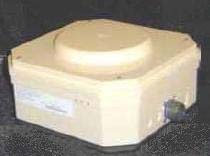
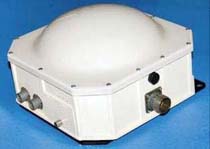
In rugged terrain, unreliable line-of-sight (LOS) radio communication continues to pose unacceptable risk of friendly fire incidents as well as reduced tactical opportunities to American forces. To counter this problem, Signalogic has developed a "voice over Blue Force Tracking" (VoBFT) prototype unit that provides beyond-line-of-sight (BLOS) voice communication in urgent situations. The Signalogic VoBFT unit inserts via existing vehicle cabling, connecting directly to existing MT-201x satcom modems installed in Humvees, Strykers, and other Army and Marine vehicles, and requiring no additional satellite bandwidth during operation. An L-Band satcom link and typical vehicle-mounted “satcom-on-the-move” MT-201x modem (MT-2010, MT-2011, and MT-2012 modems) are shown below
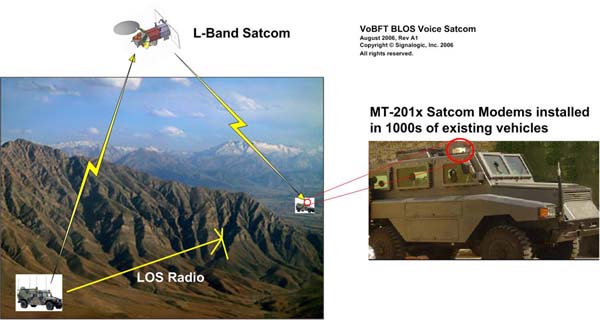
Signalogic VoBFT provides BLOS voice using existing bandwidth and equipment |
|
|
Tactical Voice Communication Examples
The VoBFT unit allows both vehicle-initiated and base-initiated voice BLOS communication. As with text messages sent over the BFT satcom network, any agent client and any transceiver client may send voice messages to each other.Mobile Vehicle Initiated Emergency BLOS Voice Comm
Below a vehicle uses a “virtual group” node ID to broadcast an emergency voice message to other vehicles. For example, in a hands-free “non keyboard” battle situation, one of up to four (4) vehicle operators would key their mic (activate PTT) and might say “whoever is shooting over Ridge 42, stop -- we’re on the other side”.
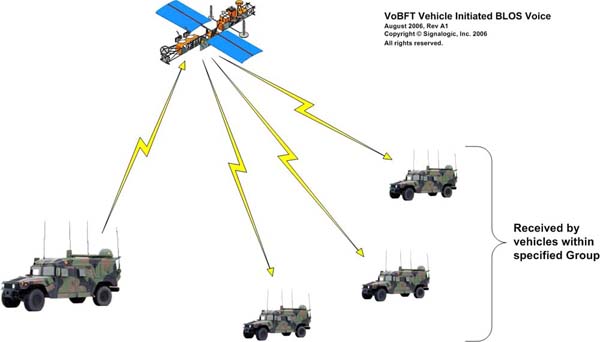
Vehicle Initiated BLOS VoBFT – voice message sent by one vehicle and received by all vehicles within a group |
Base Initiated Emergency BLOS Voice Comm
In the figure below, a base controller uses a “virtual group” node ID to broadcast urgent information to message to vehicles within a certain area. For example, in a convoy situation in rugged terrain where reading text messages might divert crucial attention away from terrain and enemy force hazards along the road, the base controller might realize an urgency in the situation and instruct his team “go to voice” – commencing to send voice messages with updated information.
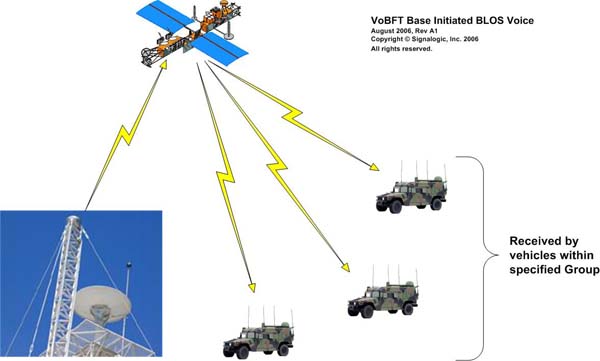
Base Initiated BLOS VoBFT – a base controller broadcasts a voice message to vehicles within a group |
“Don’t Shoot” Voice Comm
In the figure below, a vehicle operator keys the “Alert” button on the VoBFT unit and says something like “This is so and so, don’t shoot!” or other similar urgent message. With the “Alert” voice button activated, the VoBFT unit enters a “Send Now” mode, records 10 sec of voice using its built-in microphone, and subsequently transmits a series of voice messages. The VoBFT unit, comparing the vehicle’s current GPS location with dynamically stored database locations of incoming GPS location reports, sends voice messages to all Blue Forces within a specified radius.
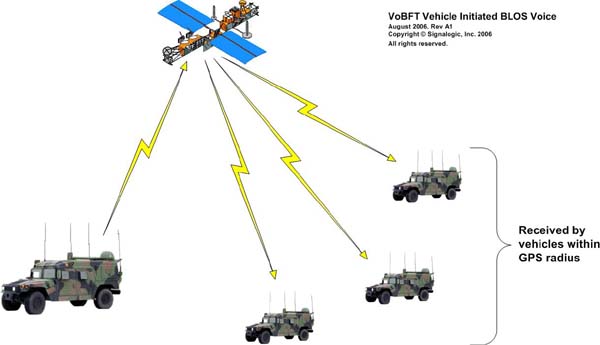
Urgent Voice Message with GPS location radius – vehicle operator sends urgent voice message to vehicles within a specified GPS radius |
Base Initiated Vehicle Identity Query
In the figure below, a base controller uses a node ID to query a vehicle suspected of not being under Blue Force control. By switching to Voice Mode, the base controller can quickly ascertain whether vehicle occupants are truly Blue Force, and as a secondary objective, whether they are acting under duress or coercion. In such a situation, a voice based communication exchange would be far more reliable then a text based exchange and could, for example, thwart a spoof indicating inoperable radios.|
Base Initiated Vehicle Identity Query – base controller sends a voice message to a vehicle of interest and verifies the identity of the speaker(s) replying |