


SigC641x-PTMC DSP Resource Module
Multi C6x DSP Module / High-Speed Parallel Processing DSP Module
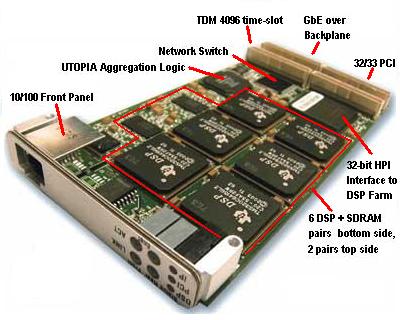 SigC641x-PTMC module, view of front bezel and bottom side. |
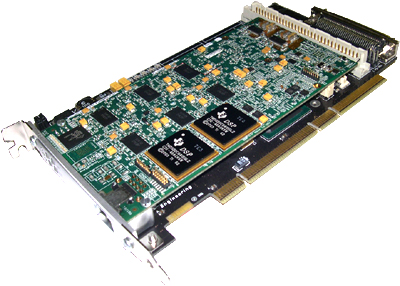 SigC641x-PTMC module installed on active adapter for insertion in 3.3V or 5V PCI slots in x86 servers |
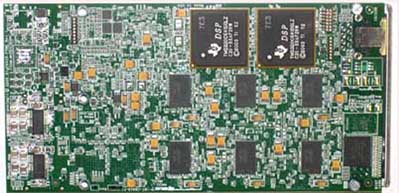 Top view of SigC641x module. Note at "left"-hand side onboard power switcher circuitry that fully supplies and manages onboard power requirements, and at right-hand side NOR and NAND Flash devices. |
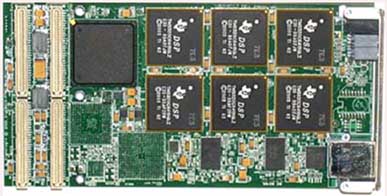 Bottom view of SigC641x board with eight C641x and 8M x 32 SDRAM pairs populated, network circuitry not installed. Front-panel RJ-45 and indicator LEDs are visible at right-hand side. |
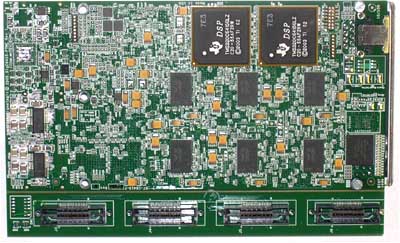 Top view of SigC641x board with Debug Tab attached. |
- Overview
- Feature Summary
- C64x Processor Family
- Block Diagram
- Software support
- Specifications
- PCI / PCIe Server Version
- Using the SigC641x with a cPCI Carrier Board
- Carrier Board Option: HW400c/2
- Channelized T3 Interface Option: wanT3
- Real-Time Video Digital and Analog I/O
- SigIMS Software / IMS Platform
Overview
The SigC641x-PTMC module achieves a new mark in high-density DSP resources, providing the highest level of general-purpose, programmable MIPS per square mm of any board on the market, in any form-factor (at the time it was released, in 2005). Previous generation boards provided single, dual, or quad C64xx processing; the new generation SigC64xx series scales from single to octal C64xx. Targeted at voice, video, and wireless applications, C64xx series DSP devices excel at a new generation of " convergence applications", sometimes referred to as "triple play", that require a high-performance fixed-point processing architecture with high amount of memory and multiple paths of high-speed I/O. The SigC641x-PTMC is a flexible, programmable number crunching machine that excels equally well at video codec processing, base-station processing, software radio, and VoIP. The SigC641x-PTMC module is a PMC form-factor board 1. It includes all necessary onboard power generation. The board is compliant with IEEE P1386.1 (PMC) and PICMG 2.15 (PTMC) standards, usable with a wide range of cPCI, ATCA, VME, and other host platforms, including:- cPCI (compact PCI) carrier board
- ATCA (Advanced Telecom Computing Architecture) board
- VME carrier board
- Servers, using PMC-to-PCIe and PMC-to-PCI adapters
- Stand-alone, with 5V and 3.3V power
- Linux -- x86 servers, PowerPC platforms, ARM platforms
- Win7, WinXP, Win2k, Win9x
- Self-managed unit, with no host software communication
- PMC form-factor board, compliant with PICMG 2.15 (PTMC) electrical specifications and IEEE 1386.1 (PMC) mechanical specification
- DSP Farm with up to eight (8) 6414, 6415 or 6416 DSPs, with 600 or 720 MHz, 1 GHz speed options
- 4, 8, or 16M x 32 dedicated SDRAM per processor
- Supports PTMC configurations 2, 3, and 5
- High-performance PCI-to-HPI32 interface allows host communication direct to DSP memory while real-time applications continue to run
- TDM interface with up to 4096 time-slots
- GbE interface, with network switch connection to DSP Farm
- 10/100 front-panel interface
- High capacity, low-noise onboard power generation
Feature Summary
Below is a feature summary for the SigC641x-PTMC module.- Up to eight (8) 6414, 6415 or 6416 32-bit fixed-point, high-speed DSP with 1M byte onchip memory and L-2 cache
- 4, 8, or 16M x 32 SDRAM per DSP
- Supports PTMC configuration 2: 2560 TDM time-slots
- Supports PTMC configuration 3: 2560 TDM time-slots, RMII interface, UTOPIA interface
- Supports PTMC configuration 5: GbE interface (no transformer)
- front-panel 10/100 interface (RJ-45)
- 8 or 16M x 8 boot Flash EEPROM, also available for non-volatile data storage
- 128M x 8 NAND Flash EEPROM, for streaming media data storage
- Fully compliant with Texas Inst Code Composer Studio (CCS) software; JTAG emulator header located on the board. JTAG chain configuration options include all DSPs, any DSP bypass, and chain truncation
- Host software support includes DirectdSP software that provides C/C++ API in Visual Studio (WinXP) and GCC (Linux) environment, and also provides MATLAB and Visual Basic interfaces
- DSP software support includes C64xx SCI board-support software that provides DSP level board support package, including example CCS projects, drivers for host PCI interface, DMA controller access, and onboard peripheral access
- Onboard DMA controller logic allows DSPs to communicate with onboard peripherals, other DSPs, and host PCI bus
- additional FPGA logic capacity available for user-defined, highly parallel DSP processing, including
- wireless system front-end data reduction (latter option requires "Mictor Connector Tab" version of the board)
- Up to 96-bit external digital I/O using Mictor Connector Tab version of the board
C64x Processor Family
The 6414, 6415, and 6416 processors are next-generation TMS320C6000 series devices, commonly known as C6x family devices, replacing older 620x and 6412 devices. Each 6414, 6415, or 6416 DSP on the SigC641x-PTMC module can execute up to 8000 MIPS when running at 1 GHz clock rate, or 6.4 GIPS maximum board performance. Each C64xx device includes 1M byte onchip fast SRAM memory, L-1 program and data cache, configurable L-2 data cache, and a range of peripherals including McBSP serial ports, Level 1 UTOPIA, 32-bit Host Port, and 16-bit GPIO. The CPU core in the C64x includes six (6) ALUs (32-/40-Bit). Each ALU supports single 32-bit, dual 16-bit, or quad 8-bit Arithmetic per Clock Cycle, two simultaneous multipliers supporting four 16 x 16-Bit multiplies (32-bit results) or or eight 8 x 8-bit multiplies (16-bit results) per Clock Cycle. The 6414 processor provides a low-cost option if UTOPIA interface to the DSP Farm is not needed, for example PCI-to-HPI32 and/or TDM interfaces are sufficient. The C6416 processor provides additional Viterbi Decoder Coprocessor (VCP) and Turbo Decoder Coprocessor features. The VCP supports over 500 7.95 Kbps AMR with programmable code parameters, and the TCP supports up to six (6) 2-Mbps 3GPP (6 Iterations), with programmable Turbo Code and decoding parameters.Block Diagram
Below is a block diagram showing SigC641x-PTMC board, architecture and data flow.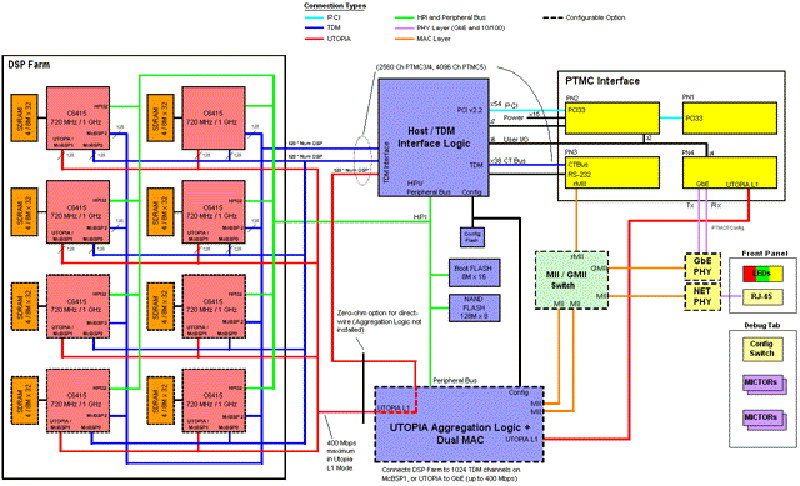
Software support
The SigC641x-PTMC board fully supports a wide range of DSP software development and integration, including voice, audio, video, and wireless algorithms, real-time processing. The C64x SCI software provides a board-support package, including example Code Composer Studio (CCS) projects, drivers for host PCI interface, DMA controller access, and onboard peripheral access. C64xx SCI supports both "host mode", when some type of host interface is used over the PCI bus (typically application layer software running on WinXP or Linux), and "JTAG mode", when only CCS and a JTAG emulator are active. Both host and JTAG modes may be active simultaneously. Via the PCI bus, DirectdSP software provides C/C++ API in Visual Studio (WinXP) and GCC (Linux) environment, based on WinXP kernel mode drivers and Linux loadable kernel module drivers. Under WinXP, DirectdSP software also provides MATLAB and Visual Basic interfaces. Hypersignal-Macro software provides test and diagnostic utilities, and instrumentation displays under WinXP and Win9x. Legacy Win9x systems are supported by VxD drivers. Debug during DSP software development and coding is supported at two levels:- Host PCI bus “algorithm level interface”
- JTAG emulator “chip level interface”
Specifications
Below are specifications for the SigC641x-PTMC board. All specifications are subject to change.|
Form Factor |
Single-wide PCI Mezzanine Card conforms mechnically to IEEE P1386/P1386.1 and electrically to PICMG 2.15 (PTMC) |
|
PTMC Configurations |
PT2MC (standard): 2560 time-slot CT Bus (PN3) PT2MC (OEM opt.): 2560 time-slot CT Bus, RMII (PN3); 64 user I/O (PN4) PT3MC (OEM opt.): 2560 time-slot CT Bus, RMII (PN3); UTOPIA L1, 6 user I/O (PN4) PT5MC (OEM opt.): 4096 time-slot CT Bus (Pn3); 1 GbE PHY port, 40 user I/O (PN4) |
|
Front Panel |
RJ-45 10/100 interface status, DSP, and network indicator LEDs 10/100 and GbE link and activity indicator LEDs |
| DSP Farm | up to eight (8) 6414, 6415 or 6416 devices (720 MHz or 1 GHz) |
| PCI Bus Interface | 32-bit, 33 MHz PCI; 3.3V signaling |
| PCIe Bus Interface | 4x or higher, up to 133 MHz clock rate, differential signaling per PICMG v1.3, active adapter including PCIe-to-PCI bridge |
| Power Consumption 2, 3 |
approx 15W @ 5V approx 15W @ 3.3V |
| Temperature |
Operating: 0 to 55ºC (airflow >200 LFM) Storage: -40 to 85ºC |
| Humidity |
Operating: 10 to 90% non-condensing Storage: 5 to 95% non-condensing |
| Pending Certifications |
FCC Part 15 Subpart B EN55022 EN55024 UL60950 3rd edition IEC60950 3rd edition |
2 Rough Estimate Only.
3 Depending on configuration.
Server Version
Below are pictures showing the SigC641x-PTMC connected to active and passive adapters, enabling the SigC641x-PTMC to operate in x86 servers as a standard PCIe or PCI card. An active adapter, including bridge device and voltage-level translation circuitry, allows the SigC641x-PTMC to be inserted into either 5V or 3.3V PCI slots. A passive adapter can be used for 3.3V-only PCI slots.
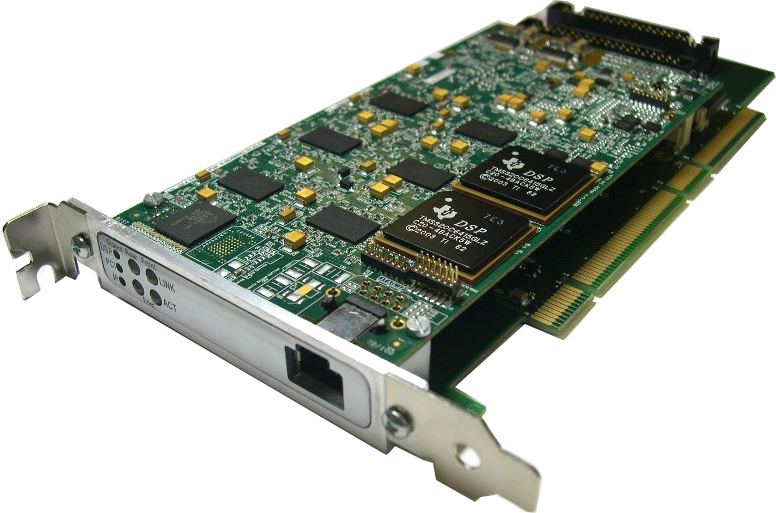 SigC641x-PTMC board installed on passive adapter for insertion in 3.3V PCI slot
|
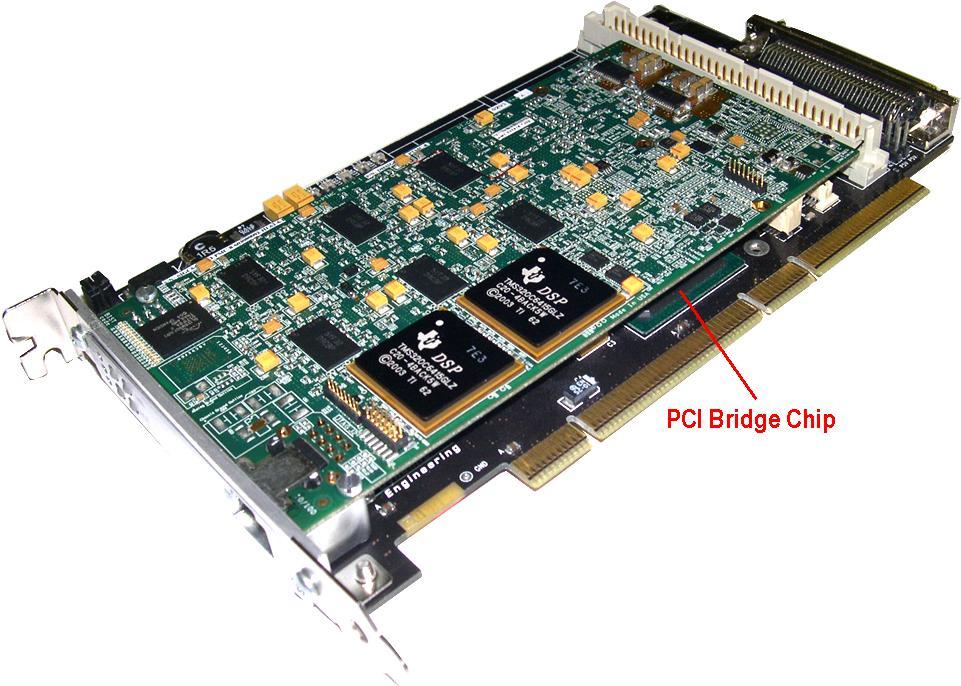 SigC641x-PTMC board installed on active adapter for insertion in 3.3V or 5V PCI slots
|
cPCI Carrier Board
Below is a picture showing the SigC641x-PTMC used with the HW400c/2 carrier board from One Stop Systems. The SigC641x is inserted into PTMC site #1 on the HW400c/2: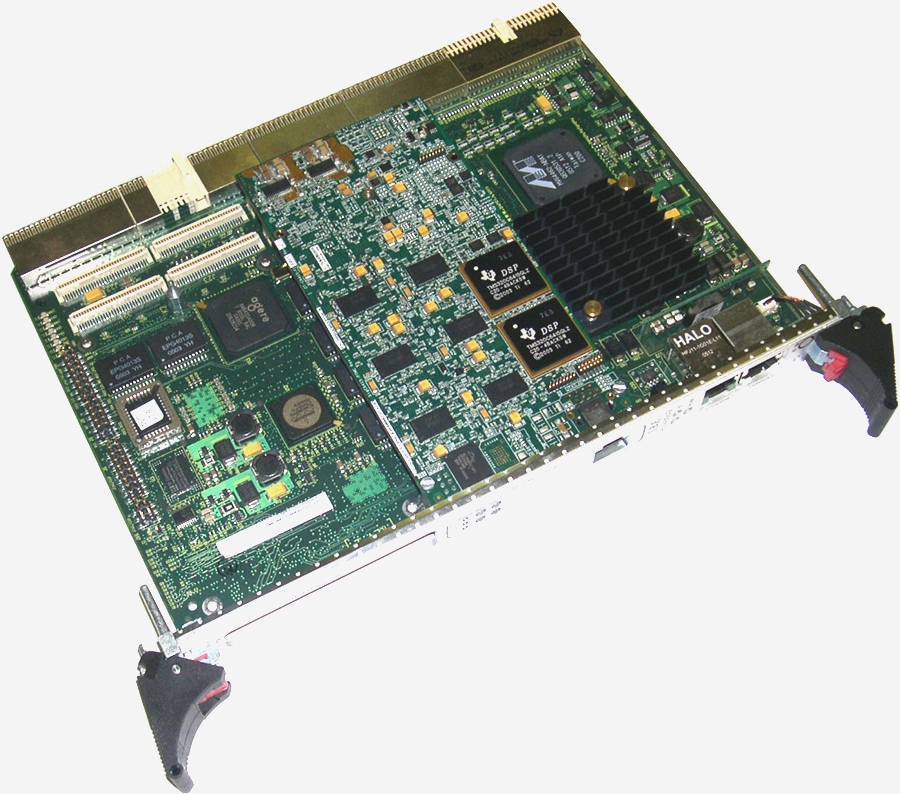 Click here to see SigC641x board, DSP connected with JTAG