SigC55xx DSP Module
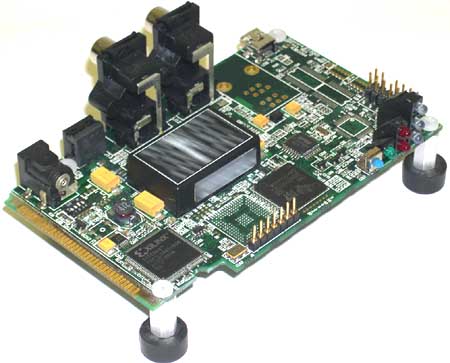 SigC5502 DSP module shown above in stand-alone mode, with
on-module 5v power input and USB Mini B connector installed
SigC5502 DSP module shown above in stand-alone mode, with
on-module 5v power input and USB Mini B connector installed |
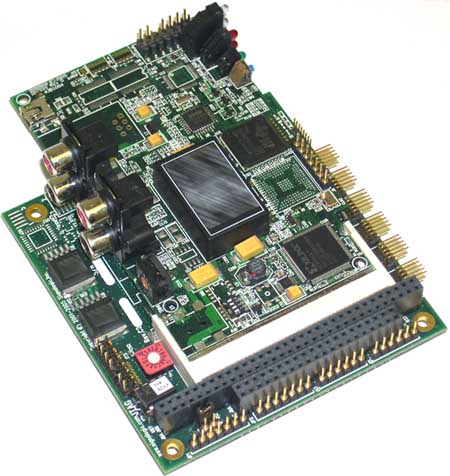 SigC5502 DSP module shown in PC/104 carrier mode, in
which PC104 board provides power (5v), host interface and sync serial or TDM
interface
SigC5502 DSP module shown in PC/104 carrier mode, in
which PC104 board provides power (5v), host interface and sync serial or TDM
interface |
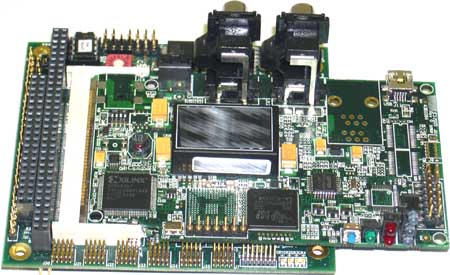 Side view of SigC5502 module with PC/104 carrier card
 |
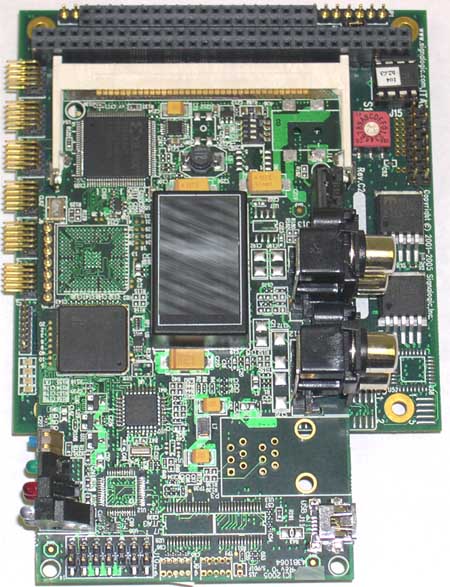 Top view of SigC5502 module with PC104 carrier card
 |
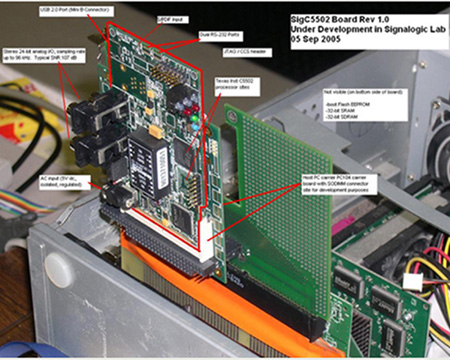 SigC55xx DSP module shown above in PC development mode. -- Click to see full size picture with captions
 |
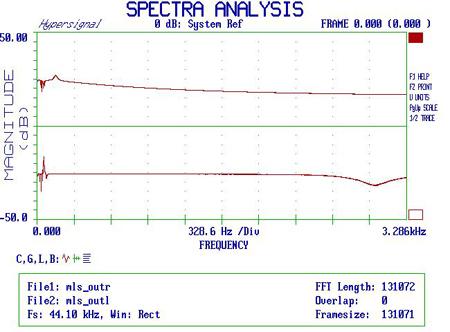 MLS Frequency response showing several parametric equalizer filters
running in real-time on the SigC5502 card.
MLS Frequency response showing several parametric equalizer filters
running in real-time on the SigC5502 card.
|
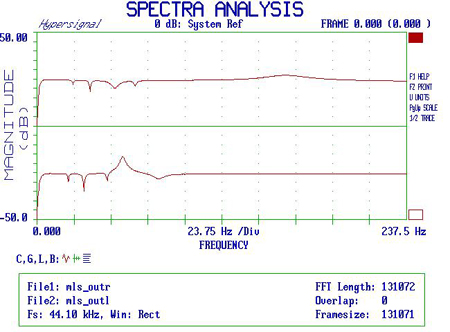 Same as above image, except with low frequency
region zoom.
Same as above image, except with low frequency
region zoom.
|
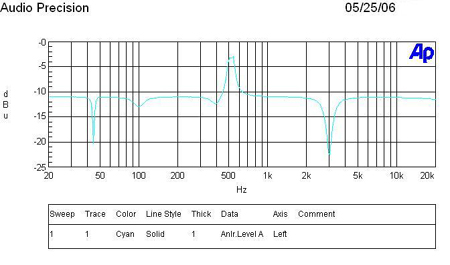 Audio Precision instrument response showing real-time equalizer filters.
|
Overview
The SigC5502 card combines high performance DSP and professional audio quality in an
ultra small, dense PCB package. One or dual 5502 DSPs (up to 600 MIPS each) provide
stereo 24-bit audio data real-time processing and a range of I/O interfaces,
including S/PDIF input, USB 2.0, dual RS-232, synchronous serial, and 8-bit
microprocessor bus.
The SigC5502 design focuses on the following objectives:
-
extremely small form-factor, suitable for "cigarette
case" type of box
- low power consumption, suitable for battery operation
- careful integration of high performance DSP and high quality
audio. Current lab measurements show non-weighted SNR
results up to 100 dB
- low-cost, with volume pricing ranging from USD 100 to USD 1000, depending on card configuration and options populated
The SigC5502 offers two modes of operation:
- stand-alone, including 5V-only ac adapter power option and boot/Flash EEPROM
- as a module on a PC104 carrier, including HPI8 host interfacee
The SigC5502 represents a state-of-the-art achievement in DSP + audio design,
offering an unprecedented combination of both high performance and practical features
that make it suitable for real-world professional and consumer audio products.
Feature Summary
Below is a feature summary for the SigC5502 card:
Up to 1200 MIPS performance,
with both 5502 DSPs are installed
256k x 32 zero-wait-state SRAM per processor
Very small form-factor, approx 100 x
60 mm
Both stand-alone operation and carrier board operation supported. Single 5V power supply with "wall wart" connector for stand-alone operation
Stereo 24-bit audio I/O using Cirrus Logic high performance sigma delta codec
Boot / FLASH EEPROM stores boot or program code, configuration and other non-volatile application data
USB 2.0 port with onboard mini-B style connector
Dual RS-232 ports
Optional HPI8 interface to host processor (using SODIMM-72 socket on carrier board)
JTAG debug/scan and Code Composer Studio software fully supported
Supported by SigC55xx Development System
which is compatible with DirectDSP®,
and Hypersignal®-Macro development software (see below)
Applicationss
Applications for the SigC5502 card include:
- real-time graphic or parametric filter equalizers
- precision filtering, using up to 64-bit coefficients
- speech and voice compression products
- arbitrary waveform generation
- very-small-form-factor and low power consumption DSP
applications, including medical, man-wearable, and
avionics
- vibration analysis
- ultra sound processing
Processors
The Texas Instruments C5502 digital signal processor
runs at 300 MHz (600 MIPS peak during dual-MAC operations). The 5502 offers a complete set of onchip peripherals, including instruction cache, serial ports, host port,
external memory interface, programmable clock PLL,
timers, DMA channels, and 32k x 16 of onchip memory.
Boot / FLASH EEPROM
The SigC5502 contains an optional 4M x 16 boot/FLASH EEPROM that
stores boot or program code, configuration and other non-volatile application data.
The boot/FLASH EEPROM is optional and should only be installed if required in
cost-sensitive applications.
Host Interface Logic
The SigC5502 multiplexes HPI
(Host Port Interface) signals for multiple DSPs and allows one or a combination of DSPs
to be accessed simultaneously during host writes (broadcast mode), and individually
during host reads. Broadcast mode includes onchip memory block writes, program (COFF)
file download, reset, run, and external interrupts.
HPI interface is only supported when SODIMM edge connector is used.
SigC55xx Development System
For more information on the
SigC55xx
Development system, please click here.
Note that the
SigC54xx-PC/104 and
SigC54/55xx-PCI boards may also serve as a development
system. If the SigC54xx-PC/104 board is used, it should be plugged into a PC using a
"passive carrier" card.
Analog I/O
The SigC5502 includes two (2) 24-bit sigma-delta analog I/O channels, implemented using a high-performance Cirrus Logic ADC + DAC codec. Sampling rate ranges from 4 kHz to 96 kHz and is software programmable. A limited amount of input and output attenuation is also software programmable, voltage ranges are jumper-selectable up to +/- 12v.
For more information on the
SigSD4 Audio
Module, please click here.
Specifications and Data Sheets
Application Notes and Diagrams
Application notes and diagrams are listed below:
SigC55xx Module Software Support
The SigC5502, as well as other C55xx platforms such as the Texas
Instruments DSK C5510 board and
SigC54/55xx-PCI
board, are supported by Signalogic off-the-shelf DSP software
products designed for DSP-based real-time processing and C55xx DSP code development,
including:
- Hypersignal®-Macro and
Hypersignal-Acoustic software
series, which offer a number of simulation and real-time instrument functions.
Simulation functions include DSP and math functions, time domain display (including
waterfall, contour, magnitude, unwrapped phase), difference equation, digital FIR and
IIR filter design, sampling rate conversion, frequency zoom, wavelet transform, minimum phase
calculation, and many more. Instrument functions include spectrum analyzer, digital
oscilloscope, stimulus & response measurement, continuous signal generation,
real-time; "snap-in"; filtering, continuous disk record and generate, and more.
- DirectDSP®
is a Windows library that provides low-level and high-level calls for user-defined C/C++,
Visual Basic, or MATLAB® programs. The DirectDSP API
includes low-level hardware control functions such as reset/run/hold, register access,
block memory transfer, DSP executable file download, etc. High-level functions include
waveform file acquire/generate, continuous signal generation and execution of any
arbitrary Hypersignal DSP or math function. DirectDSP includes strip-chart recorder,
digital oscilloscope and digital tape recorder demo program and source code examples.
- The C55xx Source Code Interface contains numerous C55xx
algorithms and functions in source and binary form, such as optimized FFTs, filters,
matrix, transcendental, trig, signal manipulation function, processor and card
initialization and analog I/O examples, etc. These functions form the basis of
higher-level software functions and instruments; modification can be used to customize
Hypersignal or DirectDSP software operation. User-defined C routine hooks are provided for
real-time algorithm development. The C55xx Source Code Interface can be used as a basic
foundation for user-defined real-time DSP systems and products



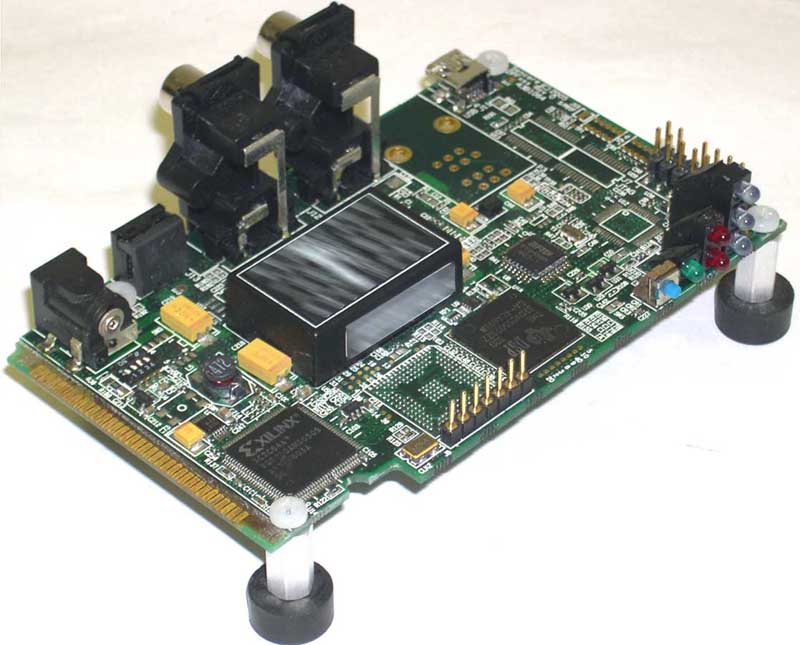 SigC5502 DSP module shown above in stand-alone mode, with
on-module 5v power input and USB Mini B connector installed
SigC5502 DSP module shown above in stand-alone mode, with
on-module 5v power input and USB Mini B connector installed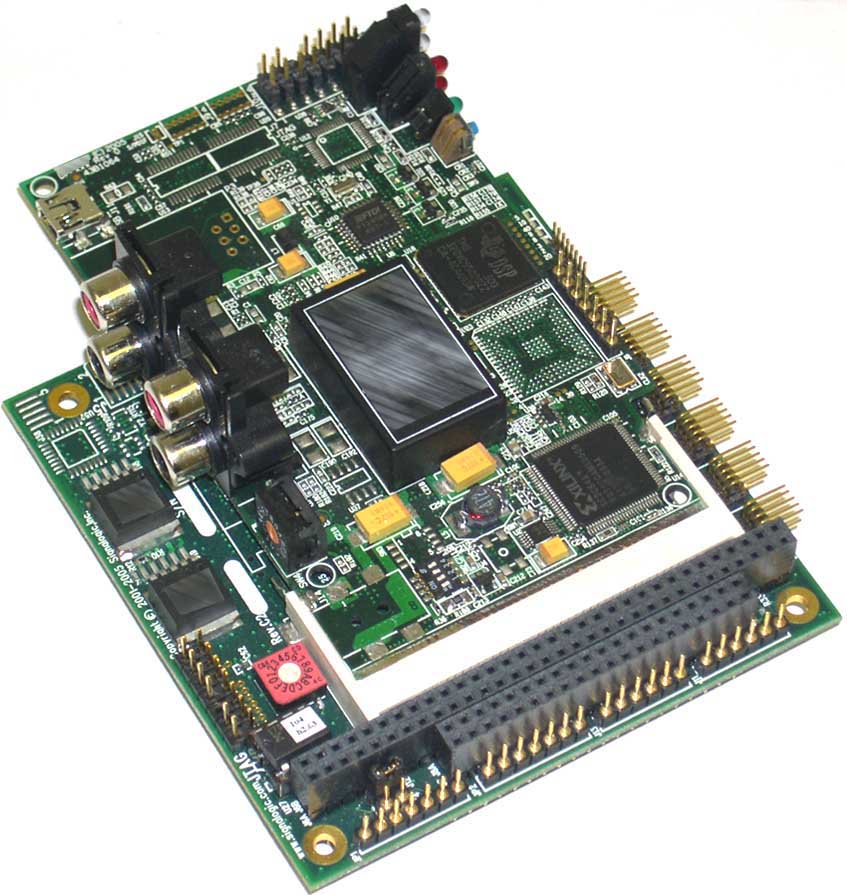 SigC5502 DSP module shown in PC/104 carrier mode, in
which PC104 board provides power (5v), host interface and sync serial or TDM
interface
SigC5502 DSP module shown in PC/104 carrier mode, in
which PC104 board provides power (5v), host interface and sync serial or TDM
interface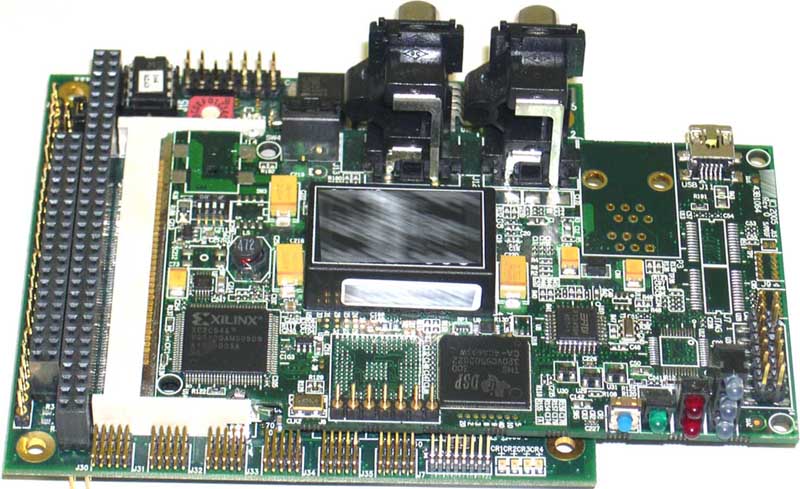 Side view of SigC5502 module with PC/104 carrier card
 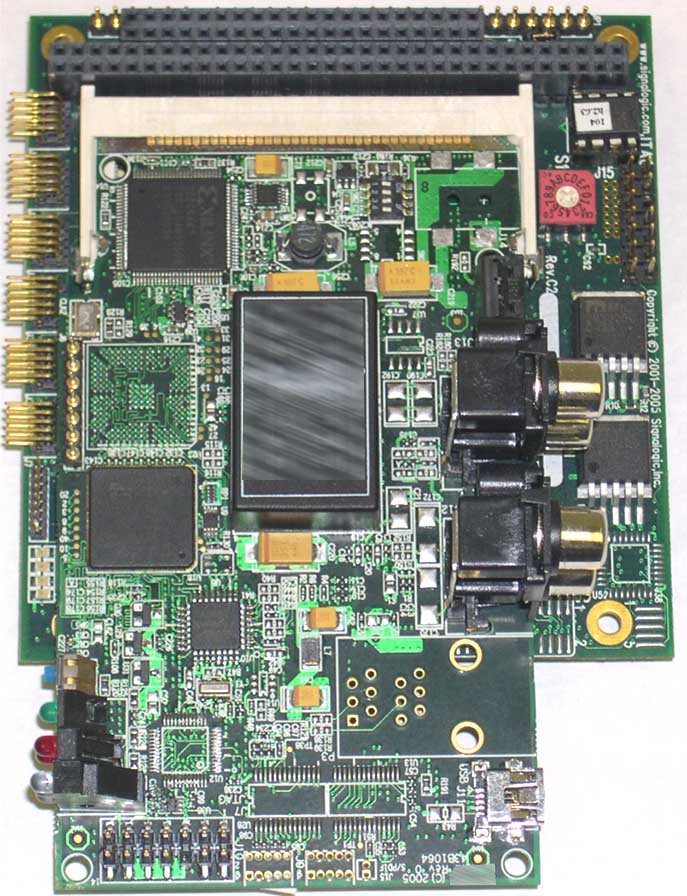 Top view of SigC5502 module with PC104 carrier card