


SigC5/6xx-PC104 Wireless Board

|

|
- Overview
- Applications
- Feature Summary
- Wireless Specifications
- Specifications and Data Sheets
- Software Support
- Features Provided by Companion
Super I/O,
SigC54xx or SigC67xx PC/104 cards - Telephony T1/E1 Interface
- Network Interface
- Serial I/O Interface
- Analog I/O Interface
- Boot / FLASH EEPROM
- Stand-Alone Operation
- Digital Parallel I/O and Interboard Communication
- SigC54/55xx DSP Modules
- SigC67xx DSP Modules
- Return to DSP Hardware Page
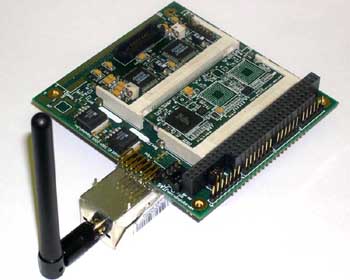 SigC5xx-PC104 Wireless Board. -- Click here to see full-size picture
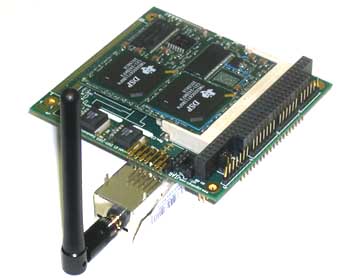 SigC6xx-PC104 Wireless Board. -- Click here to see full-size picture
 |
Overview
Applications for the SigC5/6xx-PC104 Wireless Board include base-station processing, VoIP (voice-over Internet protocol) networking functions, VoDSL (voice-over DSL), Internet routing, multiple-channel speech or audio code / decode (e.g. G.7xx, GSM, or MELP speech compression and MP3 audio compression), modem banks, echo cancellation, and speech recognition. Note: Due to the size of the 802.11b module and optional antenna, the SigC5/6xx-PC104 Wireless Board exceeds PC/104 format dimensions and is not fully compliant with PC/104 specification v2.3 in dimensions and mechanical considerations. The SigC5/6xx-PC104 Wireless Boardprovides 802.11b wireless WLAN capability when combined with either a host Pentium processor PC/104 board or one of Signalogic's DSP or communications PC/104 boards. The SigC5/6xx-PC104 Wireless Board is fully compliant with the 802.11b standard, including 2.4 GHz Direct Sequence Spread Spectrum (DSSS) 11 Mbps data rate and is interoperable with Wi-Fi certified products. In addition to 11 Mbps, data rates of 5.5, 2 and 1 Mbps per channel are also supported. The card includes an Auto Fall-Back mode. Carrier rates are selectable for North America, Japan, Europe (ETSI), Spain, and France. Modulation types CCK, DQPSK, and DBPSK are supported. The card includes hardware-enabled 64/128-bit Wired Equivalent Privacy (WEP) data encryption. An optional detachable antenna is specifically designed for embedded application solutions. When used with Signalogic DSP and I/O PC/104 boards, the SigC5/6xx-PC104 Wireless Boardcombines 802.11b wireless capability with a wide variety of I/O options, including network, telephony, and several types of serial I/O. In addition, the board interfaces with modules with Texas Instruments C54xx, C55xx, or C67xx DSP processors and modules with 16-bit audio, speech, or other analog I/O. The SigC5/6xx-PC104 Wireless Board is suitable for defense electronics, embedded telecom, Internet infrastructure, or data acquisition and measurement applications where wireless communications is required but space is at a premium. The SigC5/6xx-PC104 Wireless Board may also be used independently with Pentium based or other host processor boards.Applications
Applications for the SigC5/6xx-PC104 Wireless Board include remote data acquisition and monitoring and measurement, mobile and portable communications, wide-area networking, DSL networking, base-station processing, VoIP (voice-over Internet protocol) networking functions, VoDSL (voice-over DSL), Internet routing, multiple-channel speech or audio code / decode (e.g. G.7xx, GSM, or MELP speech compression and MP3 audio compression), modem banks, echo cancellation, and speech recognitionSigC5/6xx-PC104 Board Feature Summary
- 802.11b wireless WLAN and communications capability
- 2.4 GHz Direct Sequence Spread Spectrum (DSSS)
- Up to 11 Mbps data transfer rate
- Supports ad-hoc and infrastructure network configurations
- Compatible with Pentium PC/104 platforms running Win9x or Win2k Super I/O PC/104 boards, including
- Quad RS-422/423 synchronous serial ports
- Dual RS-232 serial ports
- Ethernet 10/100 Mbps (with intergrated transceiver)
- Quad T1/E1 telephone interface (with integrated frames/transceivers)
- USB
- Multiprocessor C54xx and C67xx DSP modules
- Parallel digital 16-bit I/O
- High-speed host interface
- Class I, II and III boards available to allow configuration with more than one wireless module, or other modules to be installed on the board
- Supports mutichannel analog I/O interface with SigSD4 Audio Module or other analog I/O modules installed
- Boot/FLASH EEPROM for stand-alone operation
Specifications and Data Sheets
- Super I/O-PC/104 Data Sheet (741 KB)
- SigC54xx_PC/104 Data Sheet (384 KB)
- SigC67xx_PC/104 Data Sheet (673 KB)
- Application External Cabling Example (7 KB)
- Application Internal Cabling Example (13 KB)
Wireless Specifications Hardware
- Onboard module, contains 32-bit NET+ARM high-performance RISC processor (NS7520 @ 55 MHz)
- 4 MB Flash and 8 MB RAM on-board memory
- High-speed TTL serial interface
- Throughput up to 230 Kbps
- Full signal support for TXD, RXD, RTS, CTS, DTR, DSR and DCD
- Hardware/software flow control
- Five shared General Purpose Input/Output (GPIO) ports
- Link integrity and Network activity LEDs
Network
- 802.11b, 2.4 GHz
- up to 11 Mbps data rate with automatic fallback
- Modulation: CCK (11/5 Mbps), DQPSK (2 Mbps), DBPSK (1 Mbps)
- Transmit power: 16 dBm typical
- Receive sensitivity: -82 dBm @ 11 Mbps
- Antenna connector: RP-SMA female
- Antenna: dipole RP-SMA male (included)
Environmental
- Operating temperature: -20ºC to +85ºC (-4ºC to +185ºC)
- Relative humidity: 5% to 90% (non-condensing)
- Altitude: 12,000 ft (3657.6 m)
Wireless Security
- WEP (Wired Equivalent Privacy)
- 64/128-bit encryption (RC4)
- WPA/WPA2/802.11i
- 128-bit TKIP/CCMP encryption
- 802.1x EAP authentication
- LEAP (WEP only), PEAP, TTLS, TLS
- GTC, MD5, OTP, PAP, CHAP, MSCHAP,
MSCHAPv2, TTLS-MSCHAPv2 - Enterprise and Pre-Shared Key (PSK) mode
Telephony T1/E1 Interface
When used with Super I/O, the combined board set provides a Dallas Semiconductor DS2155 device with integrated framer/transceiver that provides a T1/E1 interface available on a header at the board edge. Rev. D Super I/O, SigC54xx, and SigC67xx PC/104 boards provide a PMC-Sierra PM4354 device with integrated framers and transceivers that provide a quad T1/E1 interface at headers on the board edge. Up to 96 data streams may be processed by the module sites. Command, control, and status information is available to the host interface, and all TDM data is routed to the DSP module sites, via the programmable PLD switch matrix.Network Interface
When used with Super I/O, SigC54xx, or SigC67xx PC/104 boards, the combined board set provides a 10/100 Mbps Ethernet controller with PHY signals available on a header at the board edge. For VoIP applications, Packet data may be output to the network from DSPs after speech codec, RTP, and jitter processing. The Ethernet controller is accessible from both host and module sites. Note that Rev. C Super I/O, SigC54xx, and SigC67xx PC/104 boards do not contain the Ethernet controller.Serial I/O Interface
When used with Super I/O, SigC54xx, or SigC67xx PC/104 boards, the combined board set provides four (4) synchronous serial channels and two (2) RS-232 asynchronous serial channels. All serial I/O signals are available at board edge; routing is performed using onboard CPLD logic, and software programmable. Levels are software-programmable for either RS-422 or RS-423 (balanced or unbalanced). Rev. D versions of Super I/O, SigC54xx, and SigC67xx PC/104 boards also include a single channel USB interface.Analog I/O
When used with Super I/O, SigC54xx, or SigC67xx PC/104 boards configured with one or more SigSD4-SODIMM audio modules, the combined board set provides multichannel 16-bit sigma-delta analog I/O as an integrated capability. Audio module features include:- 16-bit sigma-delta converters that provide sharp anti-alias and reconstruction filter roll-off, and nearly linear phase response
- sampling rates and filter cutoff frequencies are software programmable; all channels are sampled simultaneously
- TDM (time division multiplex) serial output allows distribution of multichannel audio data to one or more DSP processors; audio data can be replicated among processors, or distributed uniformly, as needed
- analog input/output signals are routed directly to the module using a small-outline Mictor 38-pin connector that supports individually shielded conductors
Boot / FLASH EEPROM
When used with SigC54xx or SigC67xx PC/104 boards, the combined board set provides a 1M x 8 FLASH EEPROM device site for storage of boot code and nonvolatile application data. The boot/FLASH EEPROM enables stand-alone operation.Stand-Alone Operation Option
When used with SigC54xx or SigC67xx PC/104 boards, the combined board set provides a 1M x 8 FLASH EEPROM device site for storage of boot code and nonvolatile application data.Digital Parallel I/O Interboard Communication
When used with Super I/O, SigC54xx , or SigC67xx PC/104 boards, the combined board set provides a 16-bit parallel digital I/O “Global Bus”, brought out via high-density dual-row protected header. If the SigSD4-SODIMM audio module is used, an additional 8 bits of parallel digital I/O are provides for each module installed on the board. These bits are directly accessible to C54xx and C55xx processors using output instructions to the audio modules. See "Analog I/O" section for more information on the SigSD4 module.SigC54xx-PC/104 Software Support
The SigC54xx-PC/104 board is supported by Signalogic off-the-shelf software products designed for real-time code development, including:- Hypersignal®-Macro and Hypersignal-Acoustic software series, which offer a number of simulation and real-time instrument functions. Simulation functions include DSP and math functions, time domain display (including waterfall, contour, magnitude, unwrapped phase), difference equation, digital FIR and IIR filter design, sampling rate conversion, frequency zoom, wavelet transform, minimum phase calculation, and many more. Instrument functions include spectrum analyzer, digital oscilloscope, stimulus & response measurement, continuous signal generation, real-time; "snap-in"; filtering, continuous disk record and generate, and more.
- DirectDSP® is a Windows library that provides low-level and high-level calls for user-defined C/C++, Visual Basic, MATLAB®, or LabVIEW®programs. The DirectDSP API includes low-level hardware control functions such as reset/run/hold, register access, block memory transfer, COEFF executable file download, etc. High-level functions include waveform file acquire/generate, continuous signal generation and execution of any arbitrary Hypersignal DSP or math function. DirectDSP includes strip-chart recorder, digital oscilloscope and digital tape recorder demo program and source code examples. DirectDSP software provides Win9x drivers; WinXP and Linux drivers are under development. DirectDSP software also includes a telecom extension API which allows access to onboard logic functions, TMD routing / switch table functions, and the T1/E1 and network interfaces.
- VDS™ (Voice-over-packet Development System) software is an integrated environment that includes numerous development, analysis, measurement, test debug, and simulation functions for developing VoIP and VoATM systems. The VDS environment combines both simulation and real-time operating modes. It includes support for several types of off-the-shelf DSP hardware, including SigC54xx cards and systems, InterWorks™ multiprocessor telecom modules, and Texas Instruments® DSK boards. VDS test and measurement features include both packet analysis and packet impairment. Packets may deliberately be impaired with a variety of error types in order to debug and measure performance of system components such as jitter buffer and echo canceller. The VDS environment and architecture supports operation as a fully automated test system. Individual voice and audio processing components within VDS may be configured either as DSP software (DSP Mode, running on supported DSP hardware), or as host PC software components (Host Mode). Within the VDS user-interface, software components can be easily configured as DSP Mode or Host Mode in various combinations. This flexible and interactive configuration facilitates both development and analysis phases of VoIP and VoATM projects. VDS includes network-side and telephony-side configuration and management. Voice software settings include CODEC type, echo canceller, jitter buffer, silence suppression, real-time parameters, and packet impairment test and measurement options. Voice software selections made from the GUI directly set properties in the Telogy voice software running in real-time on the C54xx DSP devices.